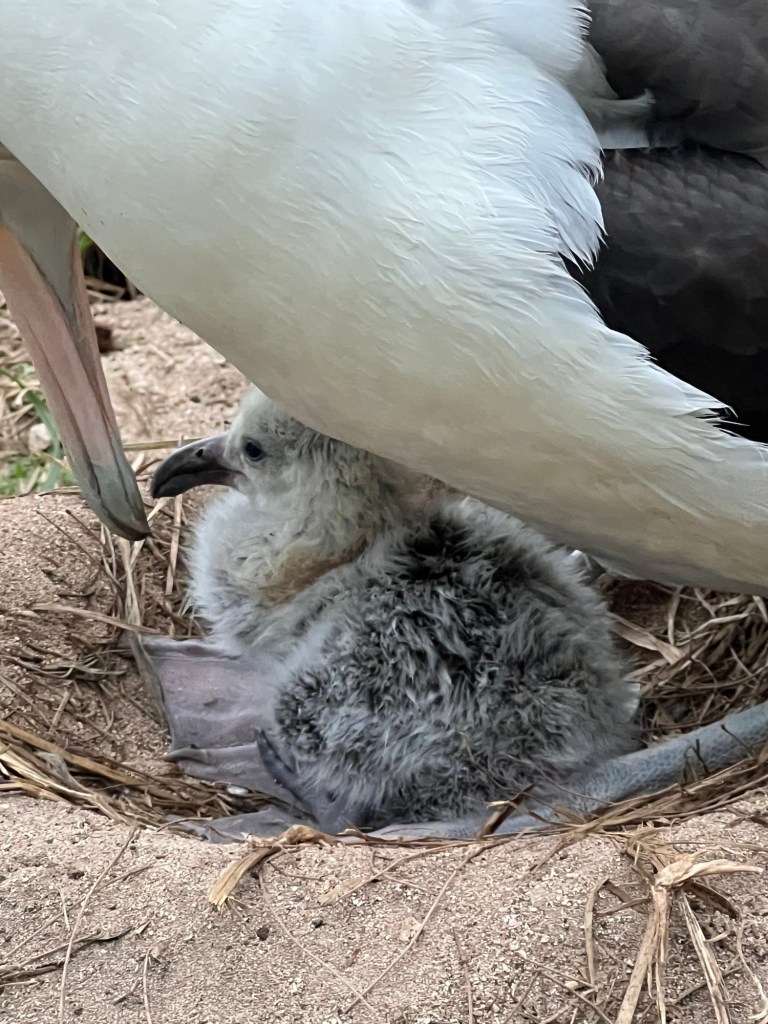
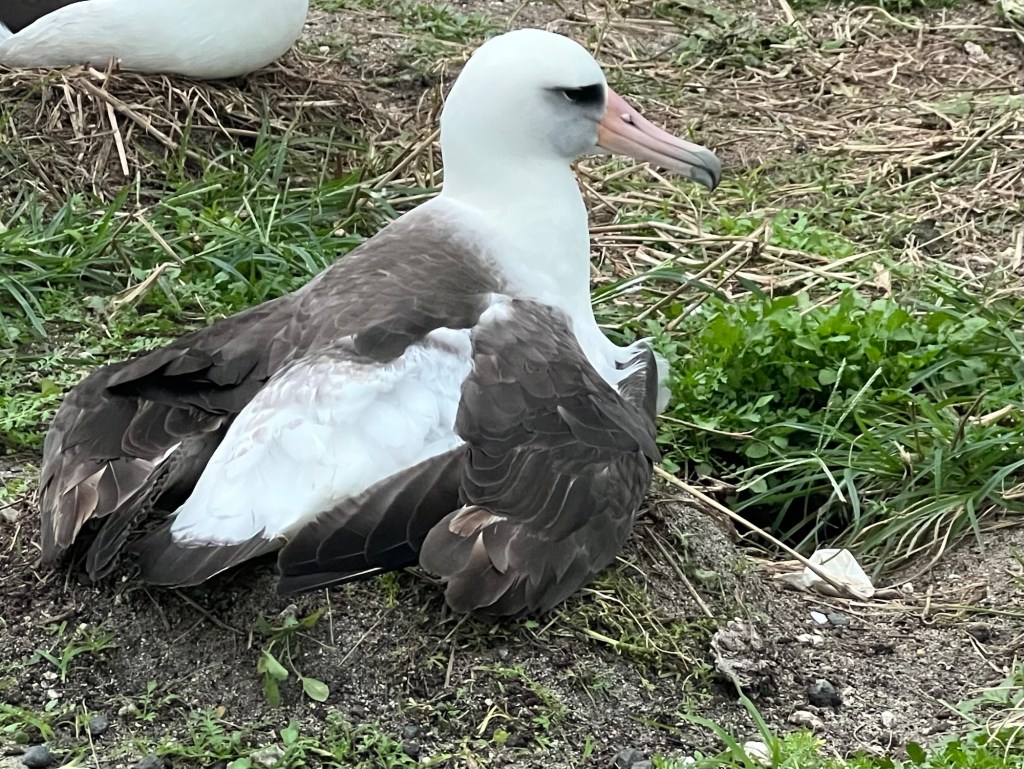
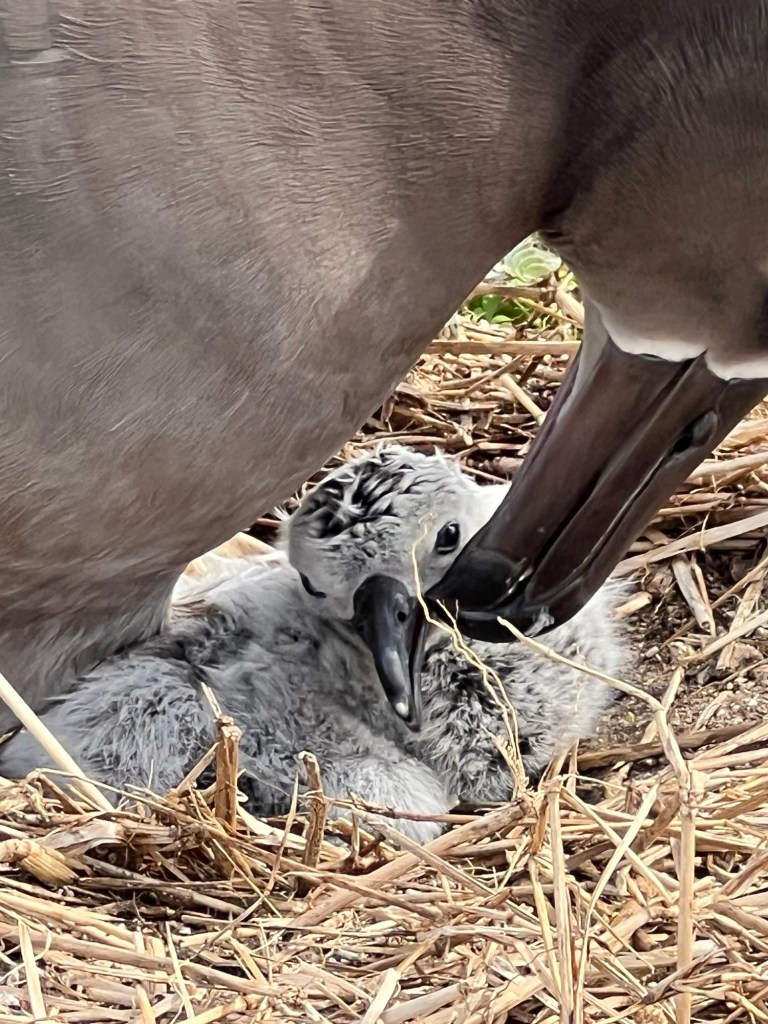
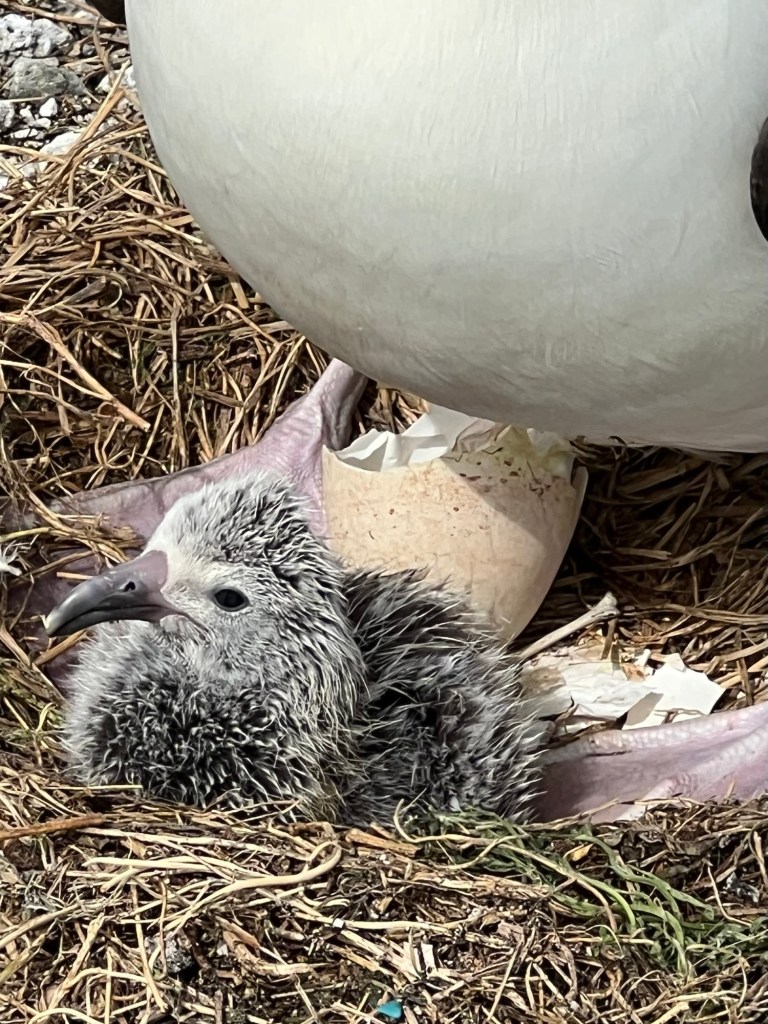
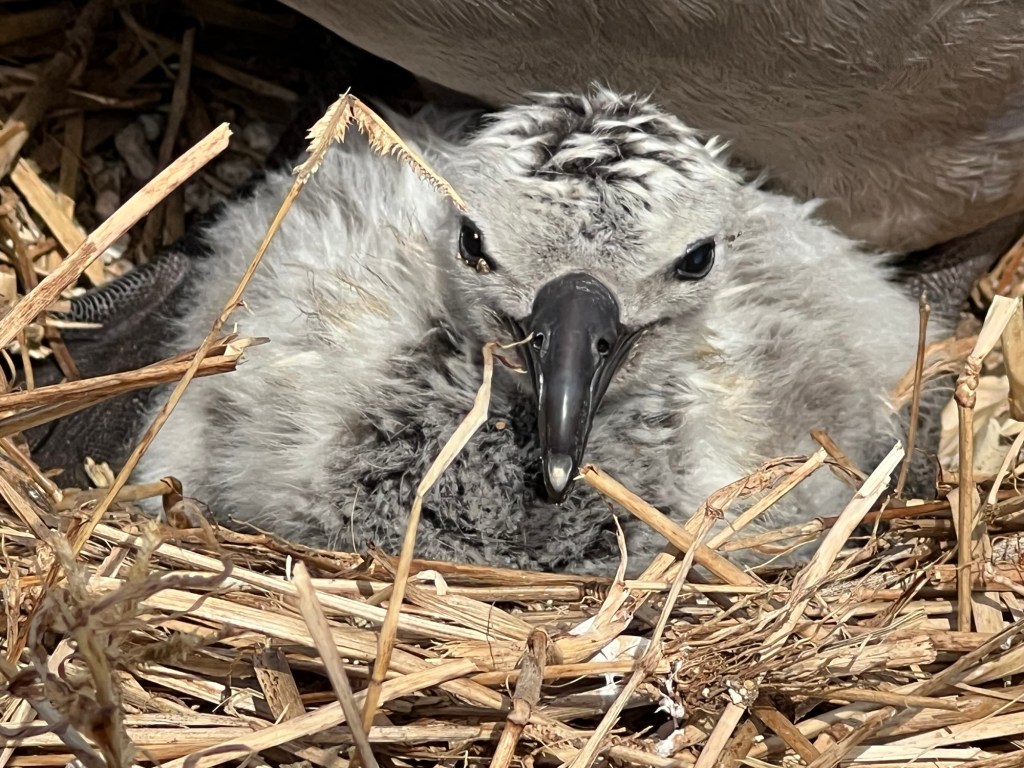
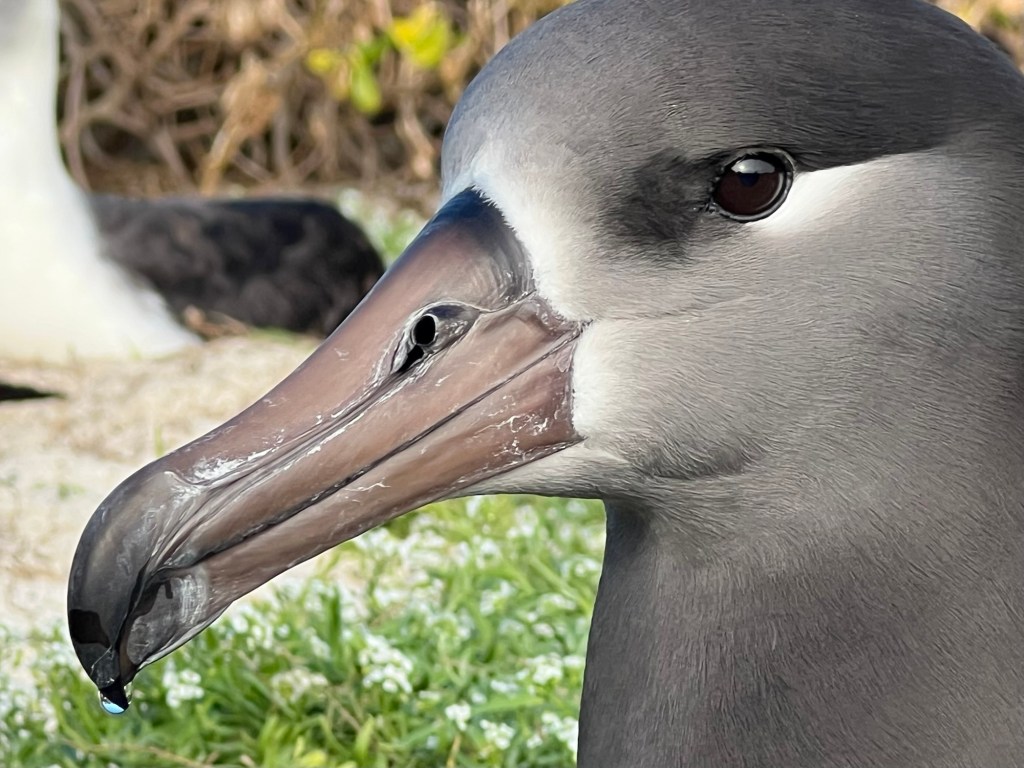
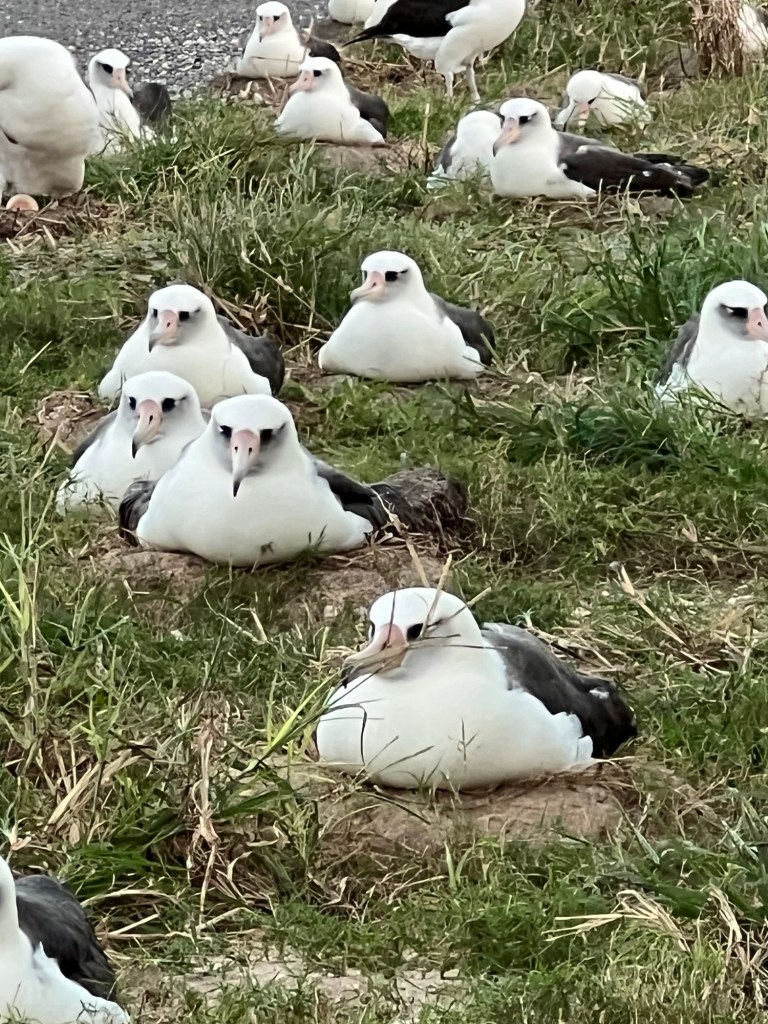
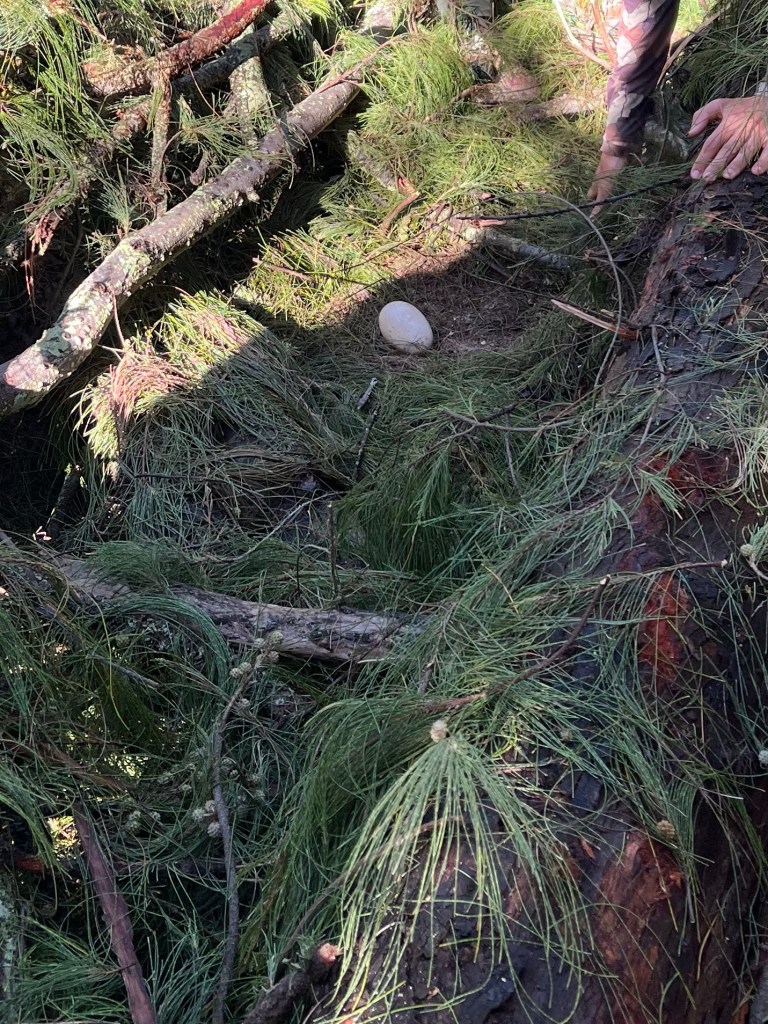
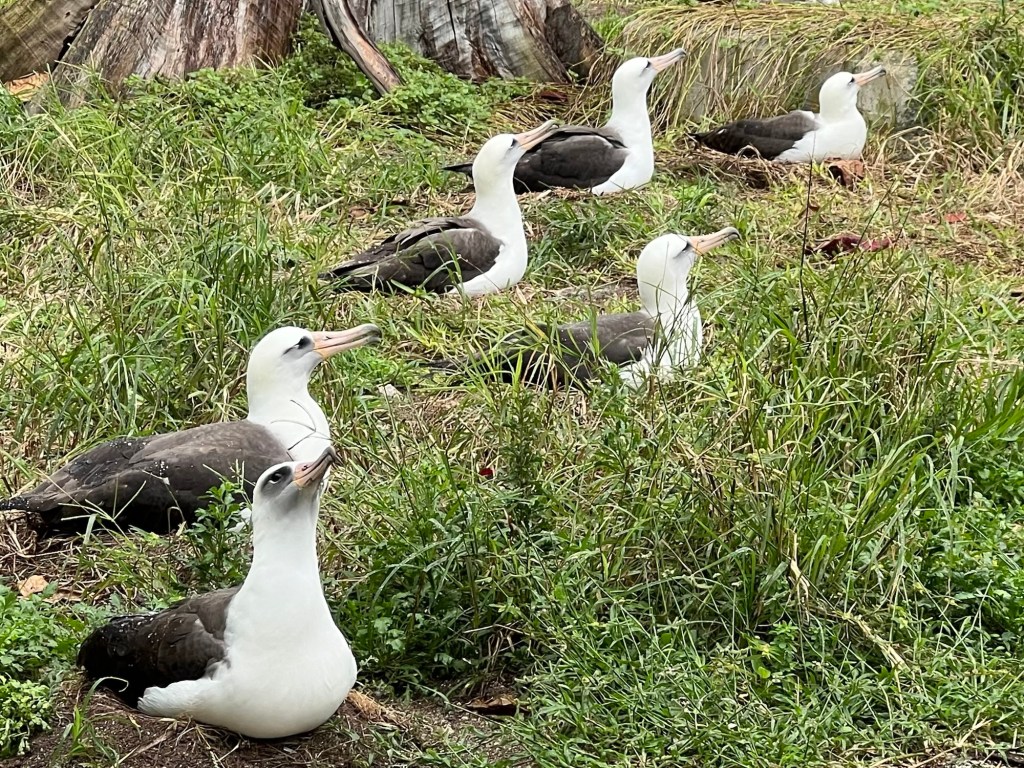
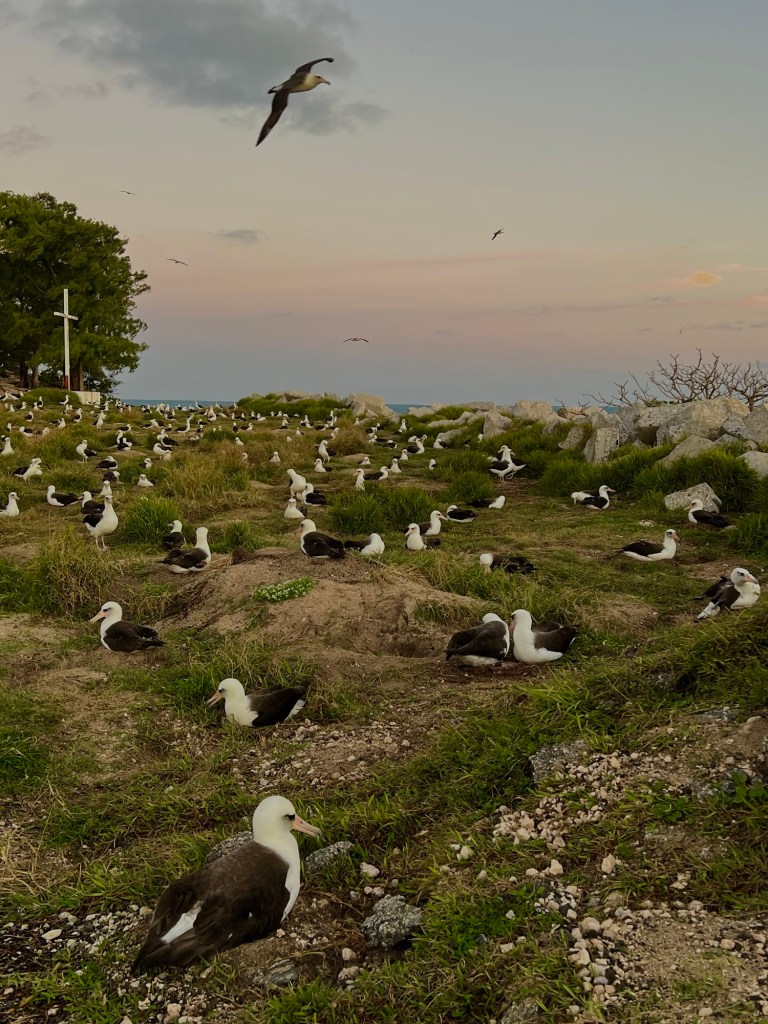
They’re popping up all over, first the Blackfooted chicks, closely followed by the Laysan. It’s a treat to see so many hatching before we leave next Tuesday (Jan 28).
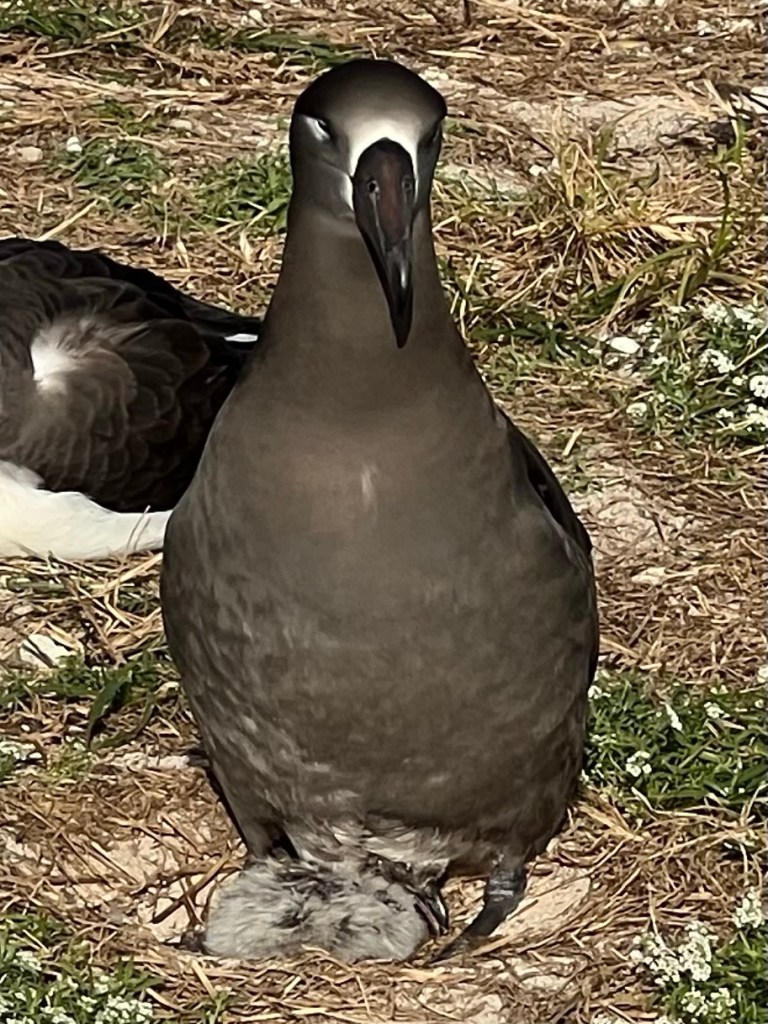
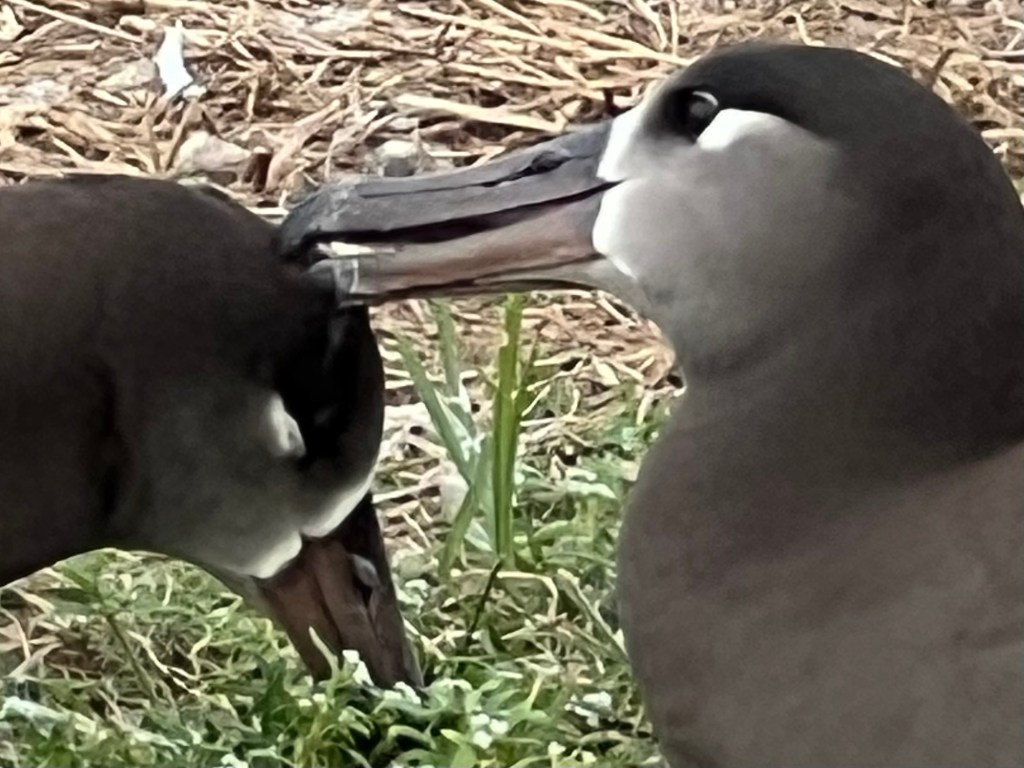
At this age the chicks, like many new borns, are simply mini eating and pooping machines. The parents seem loving and proud of their offspring as they preen and chat with them.
Even if the chick isn’t visible, there’s still evidence of their existence, with remnants of egg shell near the nest and the widespread wings of a protective parent.
We saw our first chick today…and it was so fortunate, as half our crew flew out on tonight’s plane, so they were particularly delighted to see a chick before they left the island.
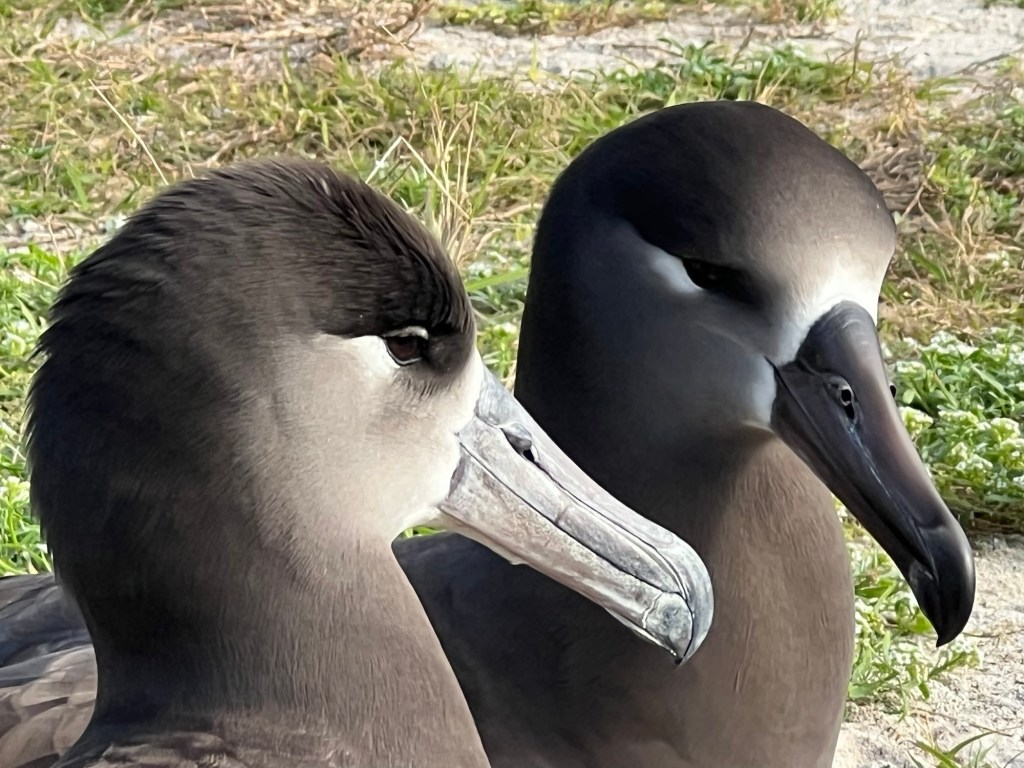
The Blackfooted albatross (BFAL) arrive just a few days before the Laysan albatross (LAAL), so it’s typically a BFAL chick that’s the first to be seen.
The chick was spotted by one of our volunteers who was biking to check out another egg that had been seen pipping earlier today. Apparently as she caught sight of the tiny gray fluffball she excitedly came to a screeching halt, as evidenced by the long skid mark!🤣
Both parents were together, gently preening one another and the tiny chick. who was likely less than a day old.
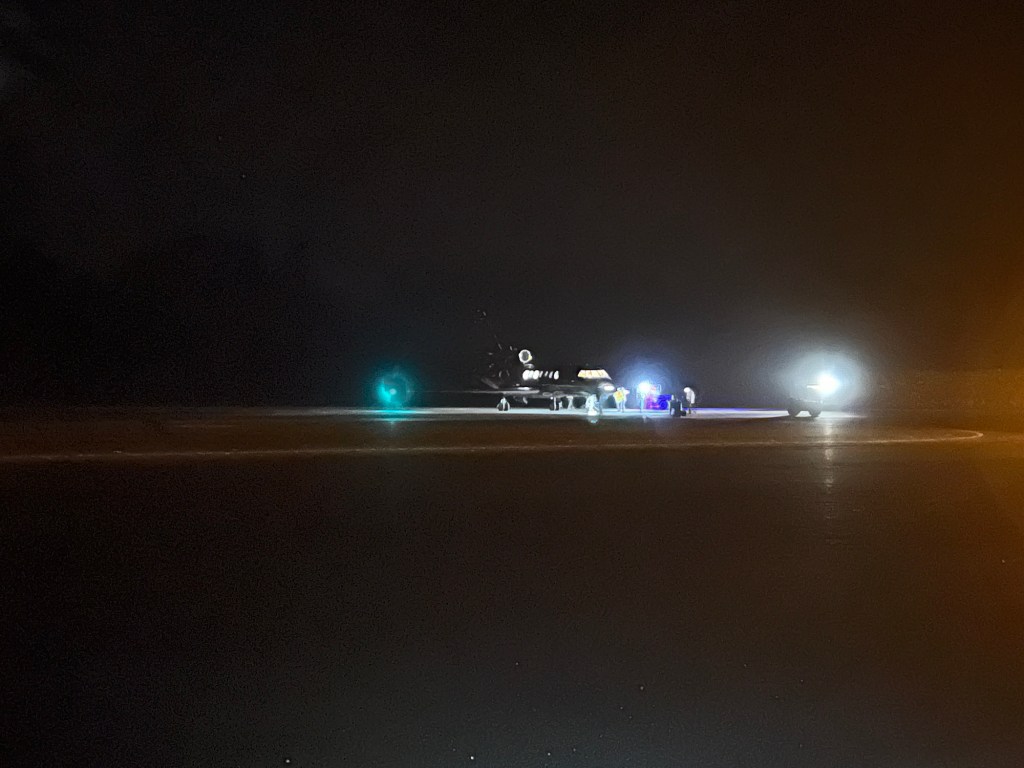
After dinner we gathered at Charlie barracks for the evening send-off, and some quite emotional farewells after such a great count; then a few of us followed them out to the airport apron (as close as we were allowed) around 9pm, and watched til the plane disappeared in the night sky.
Our work is done…at least the actual counting part is.
After a no-count morning yesterday due to high winds and the fact that our remaining two sectors included some wooded areas, I was less than confident that we could get both started and completed in just an afternoon. However, our two teams rocked it.
Thanks to the FWS efforts that have cleared trails in a very heavy naupaka sector, one team was done in record time and was able to ‘hop next door’ to our sector to help us finish, despite the weather gods playing with us. Many of us started in rain gear (just in case) but, as the temperature rose during the afternoon, layers were stripped. Then, just as we were all on our last pass, we were dumped on by torrential rain and chilling winds. Both teams were in sight of one another, and both clicked our last nests at 3:55pm!👏🎉
So now we prepare to bid a fond farewell to six of our crew who leave on Thursday night’s plane to Honolulu, though there’s still plenty of work to occupy the rest of us who will be leftovers for another two weeks.
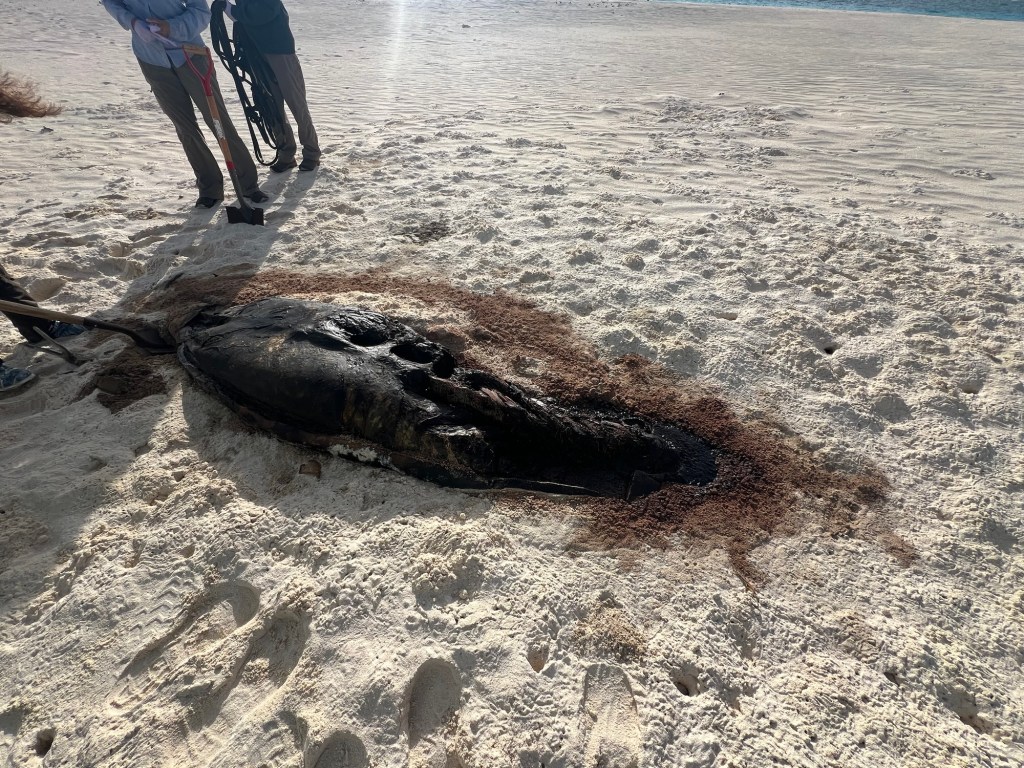
Today, we switched gears and joined FWS to move a whale carcass that had washed up a few days ago.
The next task was preparing for the upcoming Laysan duck banding, so we helped carry equipment to ‘Brackish’.
Laysan ducks at ‘Brackish’
After lunch, most of our team spent the afternoon helping FWS with seed planting in the greenhouse, while we leaders started our post-count tasks: testing clickers, identifying burrow shoes needing repairs, doing an inventory of remaining paint and other supplies.
Today the weather gods took pity on us; it was a glorious afternoon, and we had just enough time before dinner to enjoy a bike ride to Rusty Bucket, one of my favorite areas of the island, which holds special memories from past years.
On Friday we completed the last sector on Eastern Island!🎉 This is always a terrific feeling. As I mentioned, weather and sea conditions can be fickle at this time of year and have, in some years, prevented us from reaching Eastern for many consecutive days.
Sunrise over Eastern Island
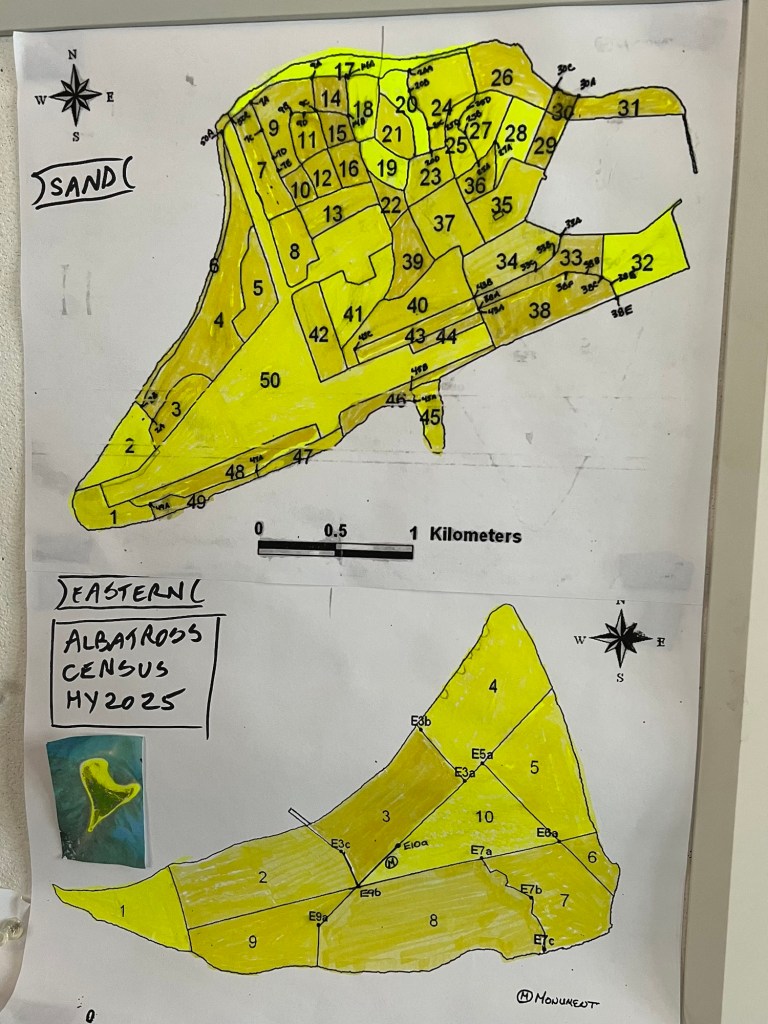
Our two teams of six worked so smoothly and professionally that we were able to count the last three Eastern sectors: E10, E1, and Spit, and were finished at 2pm. There was great celebration later that evening when those last three areas were colored in on our progress map at Clipper House.
Spit was attached from a color map but in reality lies immediately off the tip of sector E1
Spit is (was) a tiny island off the western tip of Eastern, but over the past several years the two islands have merged together as the sand has gradually piled up to bridge the two. Eight years ago we had to make a separate wet landing on Spit; four years ago we simply walked across a stretch of pristine bare sand between E1 and Spit.
Since then, the vegetation is now filling the gap. It’s fascinating to see the landscape changing, while at the same time Eastern Island is eroding along its east edge, and the resident birds on that side are being forced to share reduced real estate. Given their nesting site fidelity, it’s possible it could be some years before any nesters choose to inhabit the new land that is growing on the other side.
This coming week will be a final push to count the remaining six sectors on Sand Island which will complete this year’s census.
To celebrate the completion of the count on Eastern, here is a selection of images and memories.
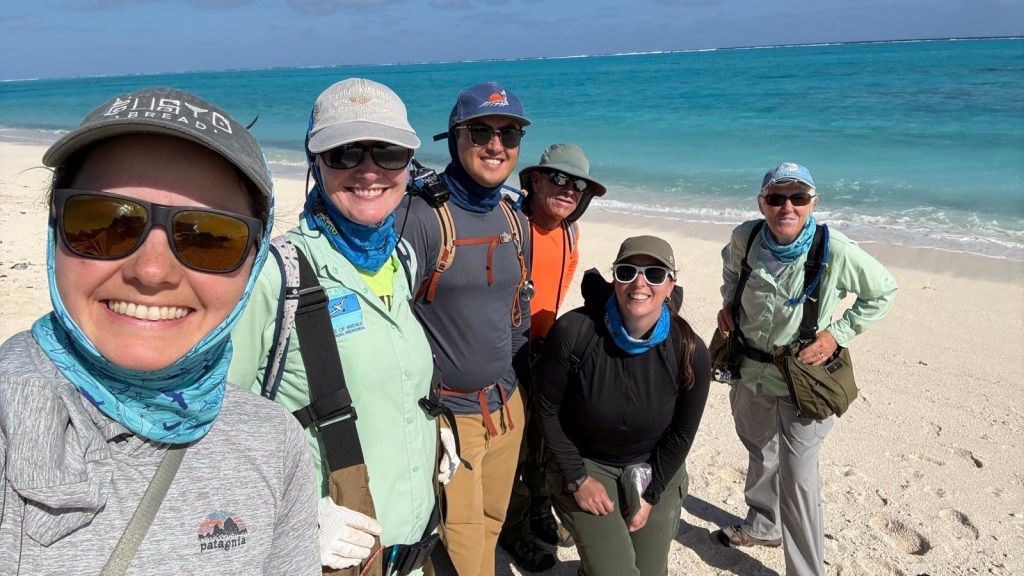
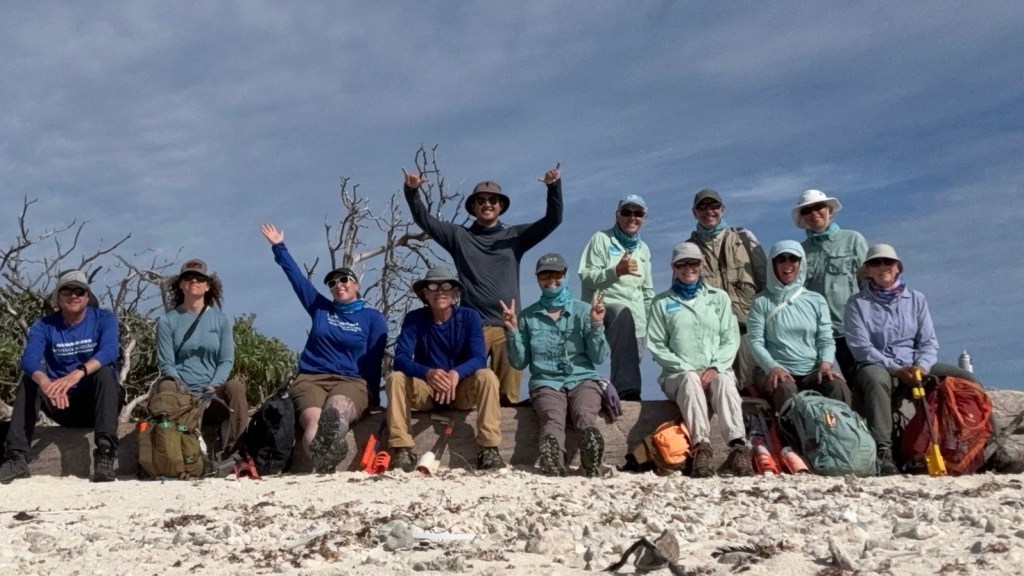
Checking for seeds from invasive Tribulus before leaving Eastern, to avoid spreading to Sand IslandAlas, poor puffer!Who you lookin‘ at?!Lunchtime companionsOur crew of sixThe entire count team celebrates completing the nest count on Eastern Island [credit: Ashley Hopkins]Landing craft approaching for beach pickup
We’re experiencing a couple of very stormy days. I realize this might be not be much compared to the freezing weather that’s been crossing the US mainland, but it was enough to stop our count this afternoon.
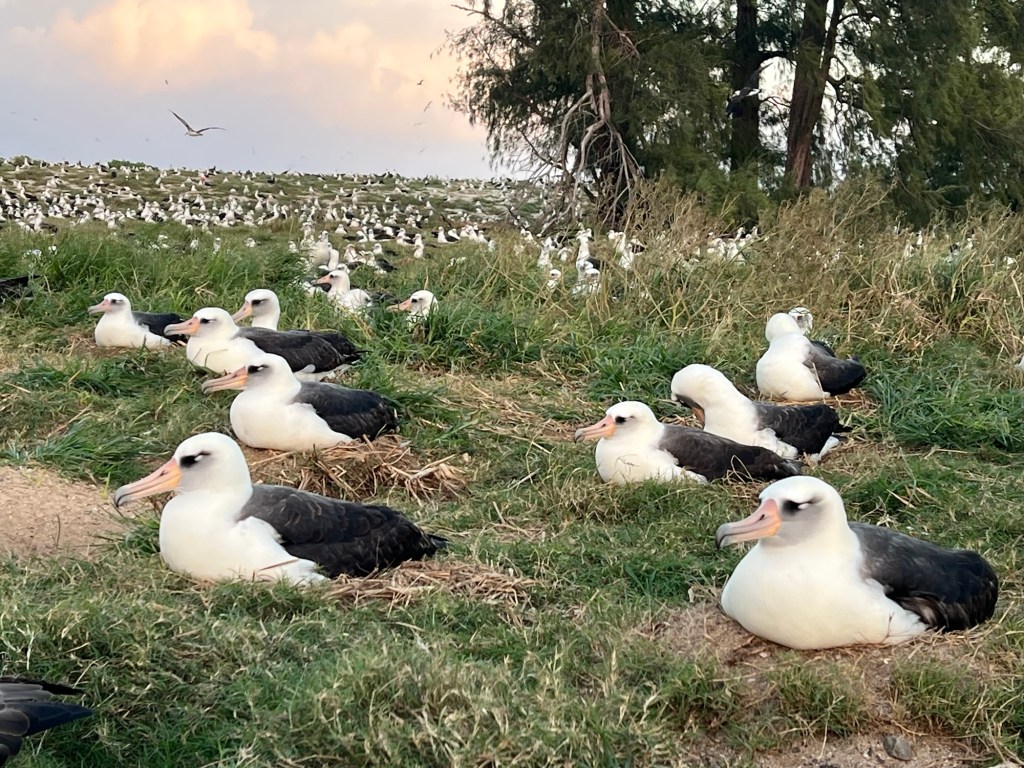
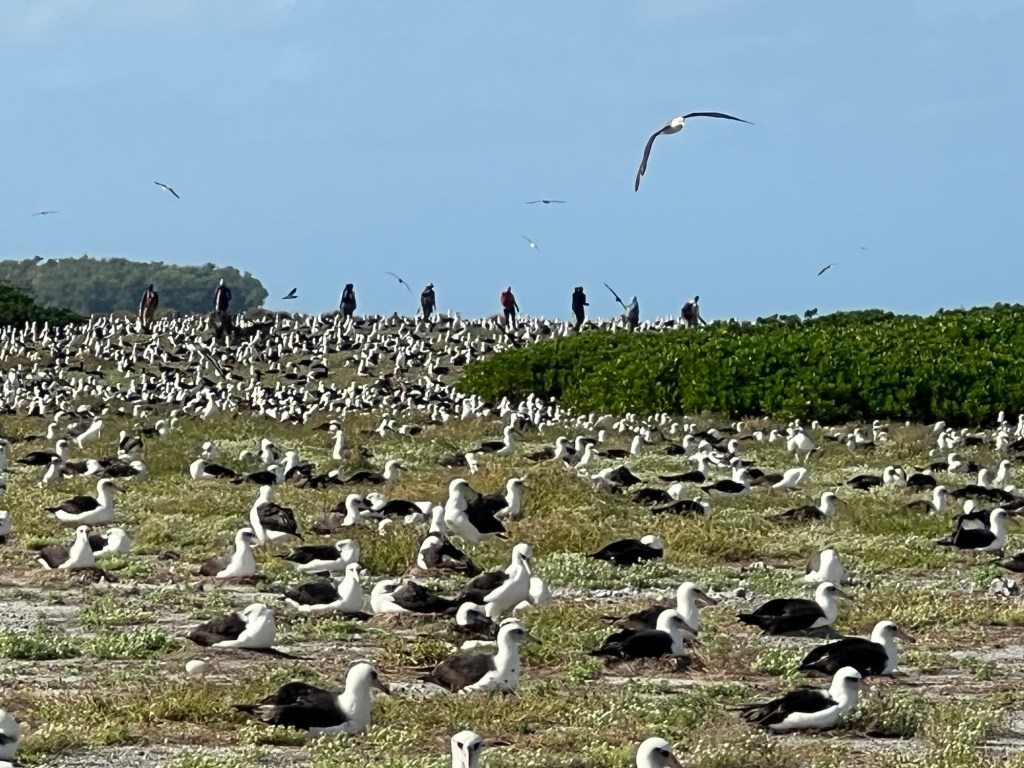
The albatross were hunkered down, all facing into the wind, with their heads tucked into their bodies, weathering the storm.
However, we had been able to count this morning, and were delighted to complete two sectors despite the intermittent vicious rain and consistent intense winds. These were our only feasible sectors, given the conditions, as they’re both in the town area, well protected by surrounding buildings, and relatively open terrain with few trees.
Nests in one of our two ‘town’ sectors today
Our concern is now for the albatross and particularly those nests in the forested areas, at risk from falling branches. We always set out in trepidation after this kind of storm event, wondering what devastation we might find in the woods once we’re able to resume our count.
As an example, on Christmas Eve our team discovered an albatross sitting on its nest, trapped by a recently fallen tree.
Miraculously, although evidently shaken by the experience, it didn’t appear to have a major injury. The mass of entangled branches and weight of the tree were impossible to move. However, once we had extracted the bird, we set about clearing the nest and were able to make an opening large enough for him/her to return to the egg. Here’s hoping…
New Year’s Eve was another trip to Eastern Island — an incredibly successful and satisfying day.
Between our two teams of six counters in each, and with the addition of two very much appreciated FWS extras, we finished off the sectors that we’d left half-done on our last trip, E9 and E7, and completed two others, E6 and E2.
A four-sector day is a big accomplishment, especially when they are Eastern sectors. The largest of the four, E2, was the last to be conquered, and we shared it between the two teams, working from opposite sides until we met in the middle, and ended with all 14 counters in one line! At one point, our group was looking far into the distance and caught a glimpse of the other group moving into position for their next transit.
The weather cooperated, with some cloud cover that kept the temperature pleasantly around 70-72degF.
As on our last visit, we found another great lunch spot on the beach, though we had to shift a little further from our planned position when we discovered a monk seal had already claimed that area for a sunny nap.
Monk seal snoozingLunch time fly-bys
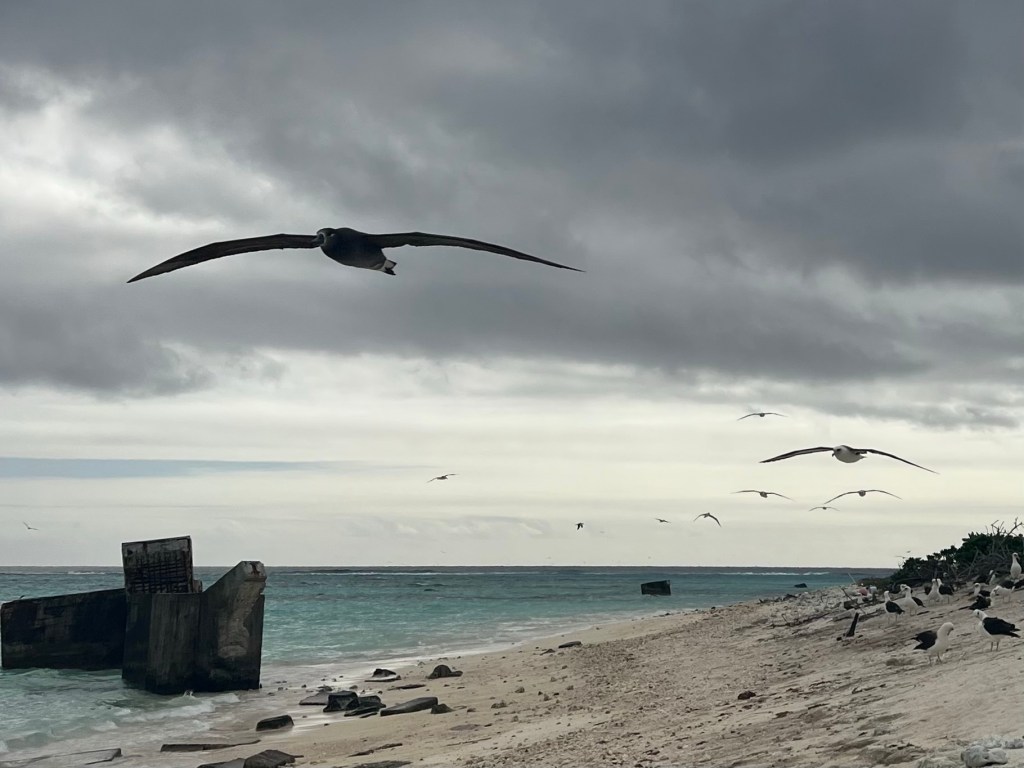
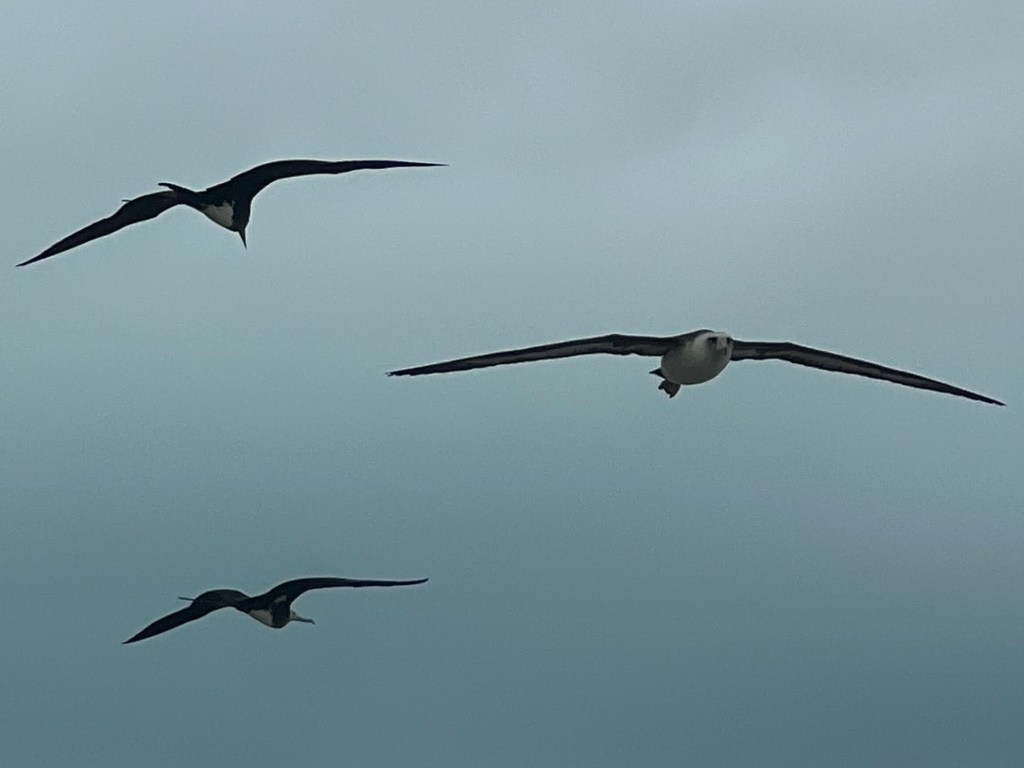
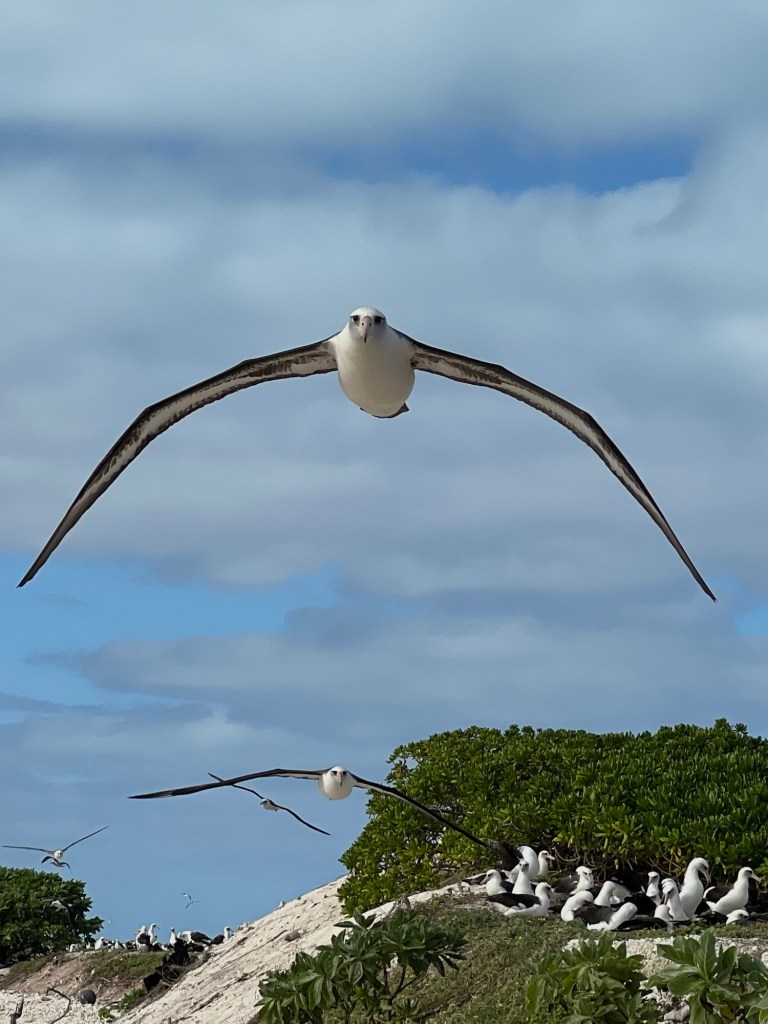
As well as the delight of a continuous stream of albatross flying overhead as we ate, several red-tailed tropic birds gave us a squawk-accompanied aerial display, and a couple of frigates passed by, as well as a gull (not sure which one) that the avid birders among us very excited.
Red-tailed tropic bird displayFrigates passing an albatross
One counter narrowly escaped what could have been a serious bird strike when an incoming albatross chest-bumped the side of her head. Luckily, she saw it coming at the last moment and avoided a full head-on impact.
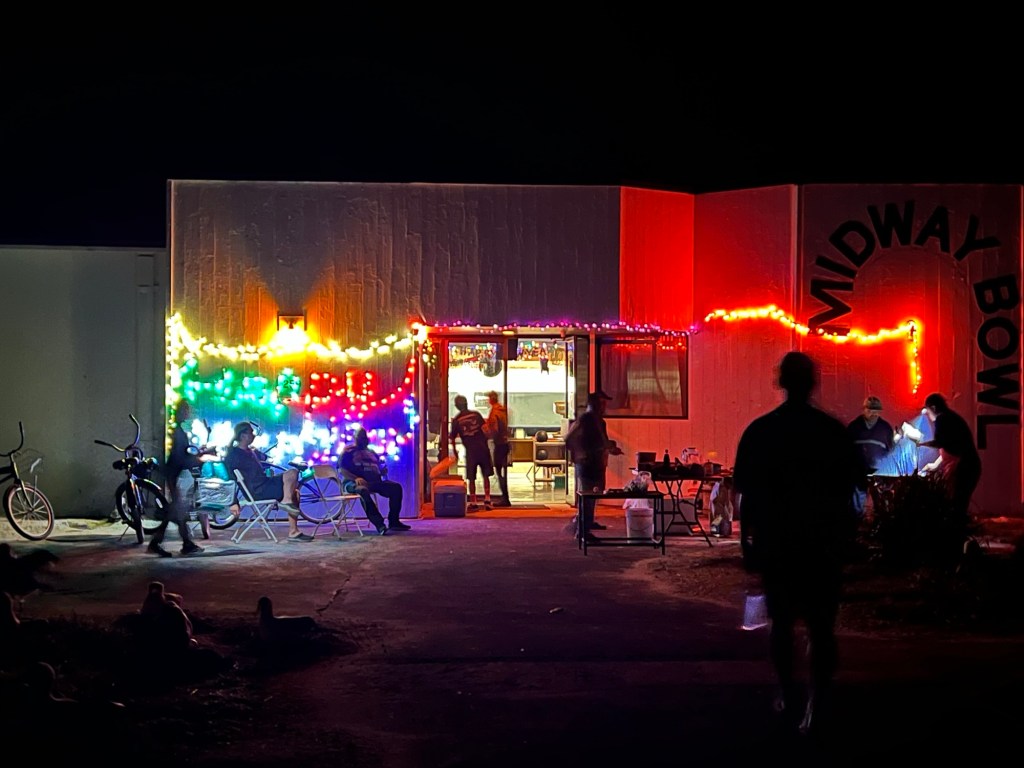
Back on Sand Island, folks had been busy preparing for the traditional New Year’s Eve festivities, which started at 7pm. The Bowling Alley was decked out with lights, and burgers and hot dogs were on the grill outside.
Bowling Alley
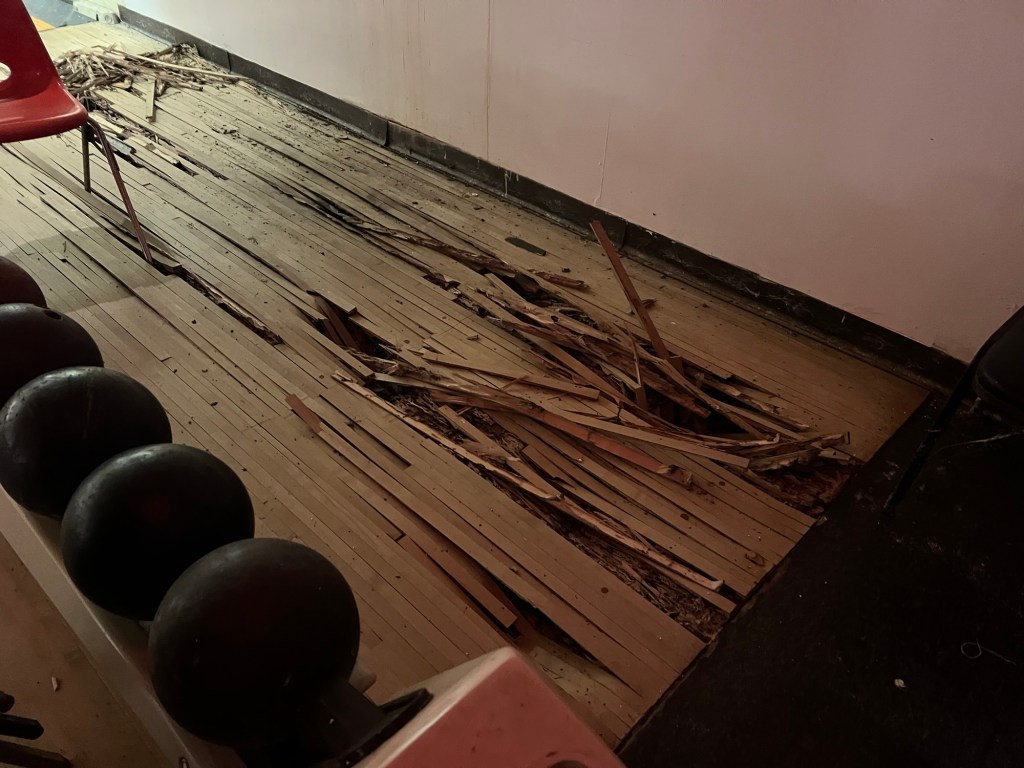
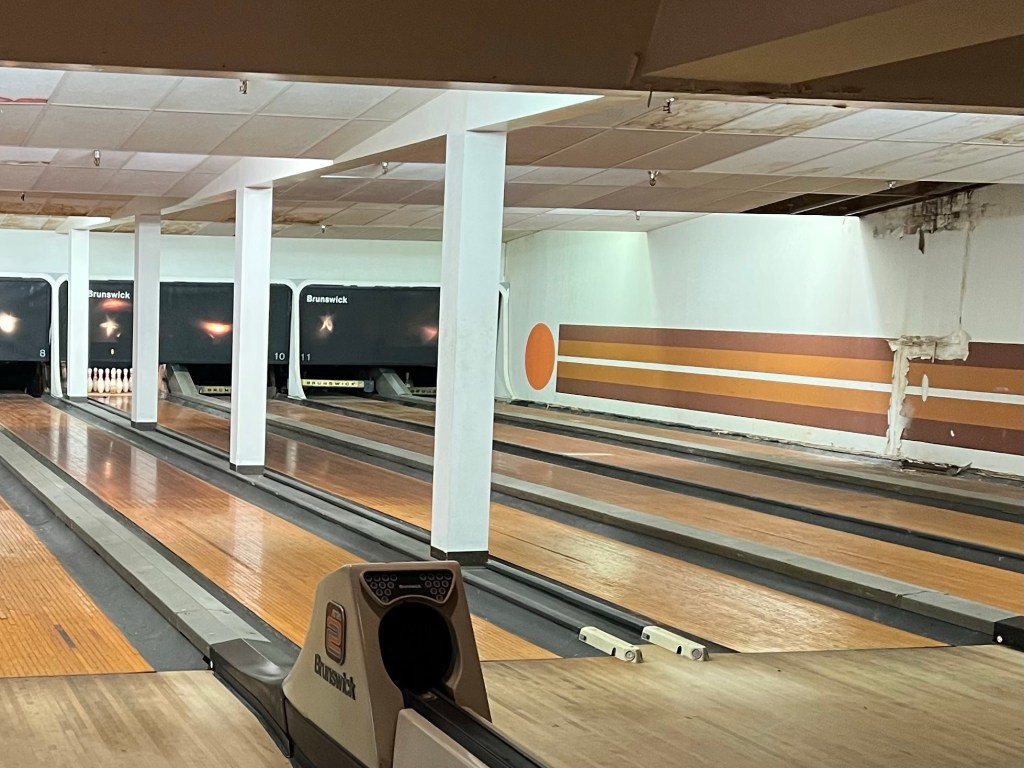
Inside, as everyone gradually arrived, some (including me) played shuffleboard, some played table tennis, some bowled, and others were at the pool table. The bowling alley, like so many of the buildings that are well past their intended life span, has seen better days structurally, but two of the lanes are still functioning.
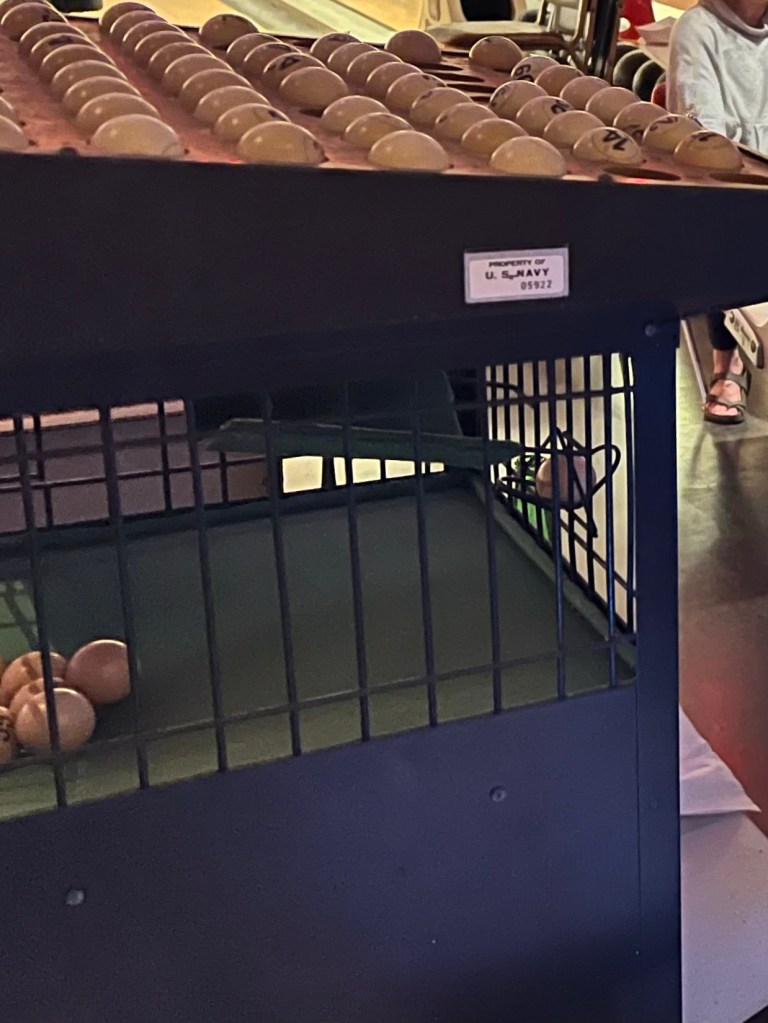
The main event is always Bingo, using the equipment—bingo cards, cage and balls—from the Naval Base days of the 1940s! We were all encouraged to grab as many cards as we could handle!🤣
Bingo…Property of US Navy!
With our medical PA as ‘caller’, and incidentally educating us on the various B vitamins as she called the B numbers, we played the typical games: one line, corner to corner X, block of nine, and finally blackout; each game winner receiving a generous gift voucher to the Ship Store. I’m happy to say I won the blackout game.😊👏
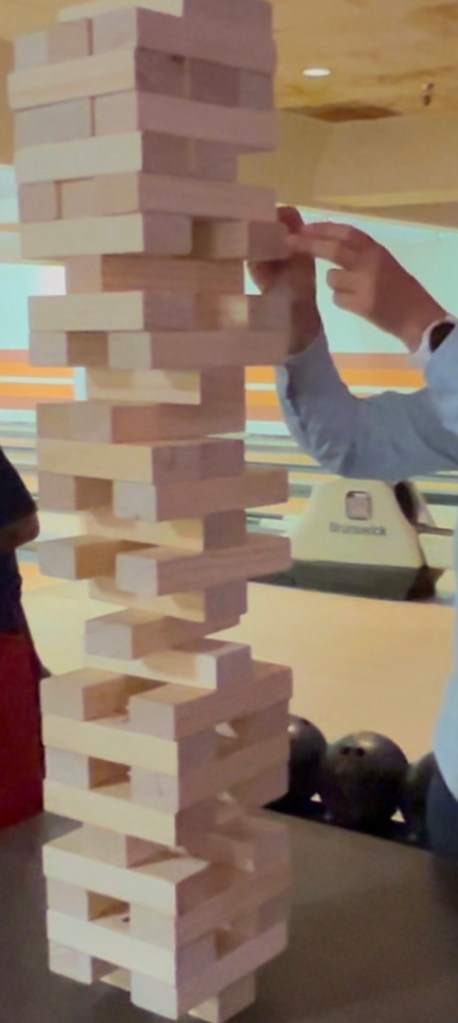
After Bingo, fun and games continued, plus eating, drinking, dancing, and a very entertaining session of Jenga, with some impressively steady hands extracting the bricks.
On the way home, which is just a short walk between the Bowling Alley and our Empire Café house, the sky was a sparkling mass of stars to boot out 2024 and usher in the new year.
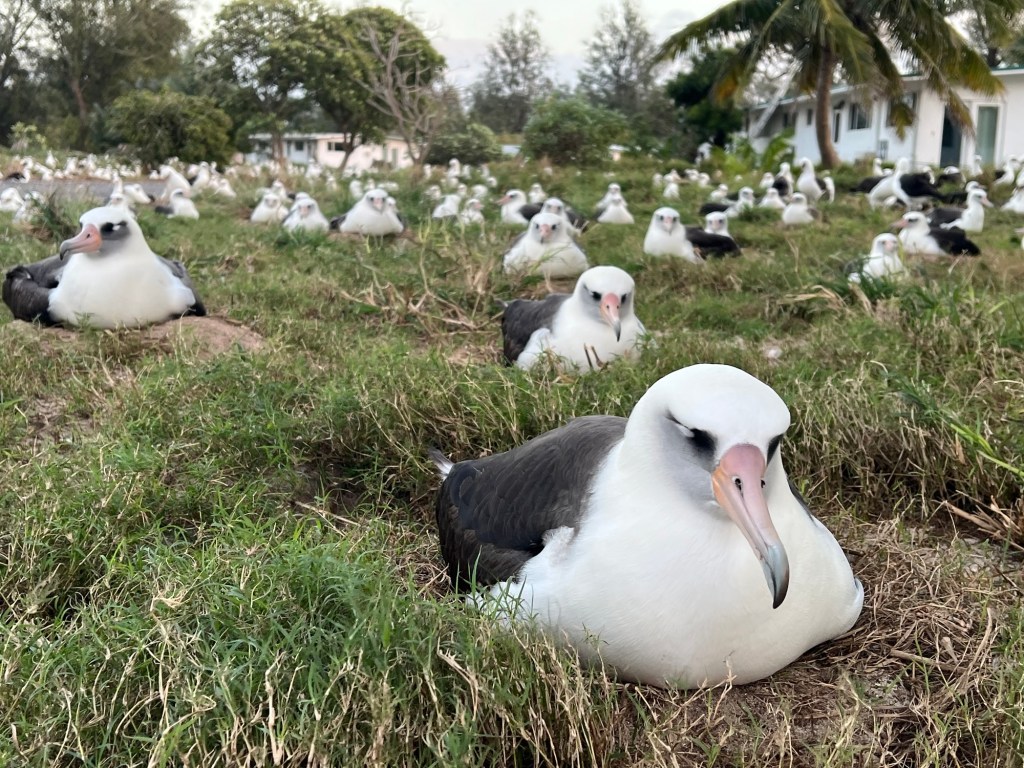
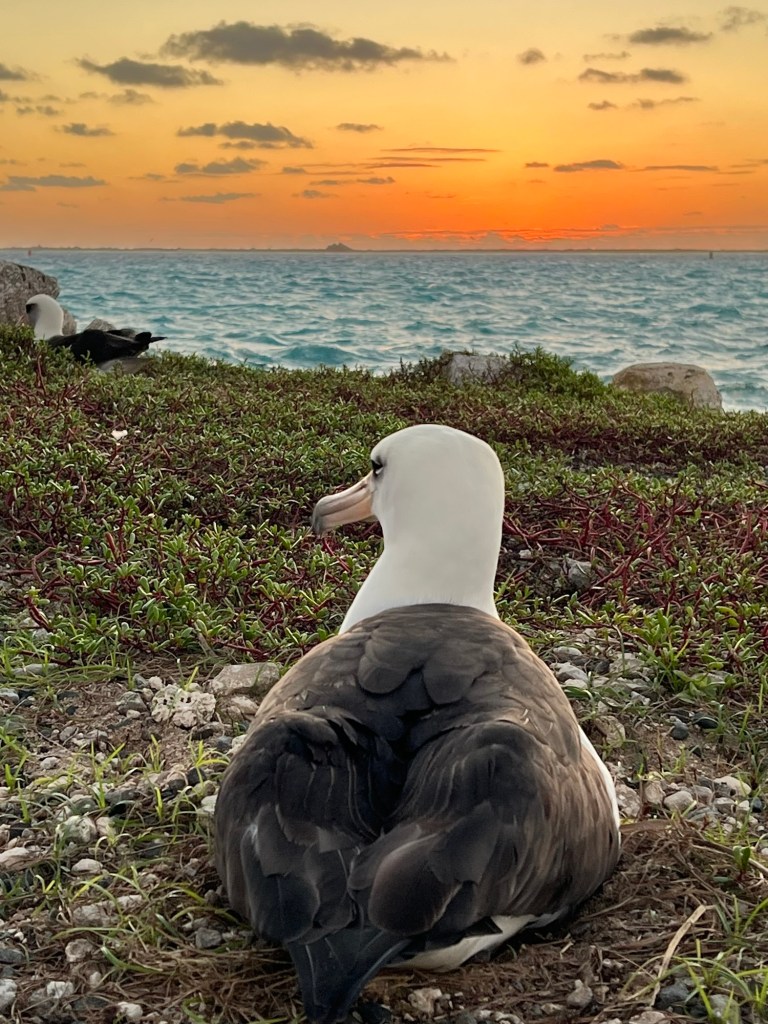
New Year’s Day is of course a holiday for everyone. So, it’s been a leisurely start to the day so far, mostly sunny but with a brief squall that had the resident Empire Café albatross lifting their heads to catch a few drops.
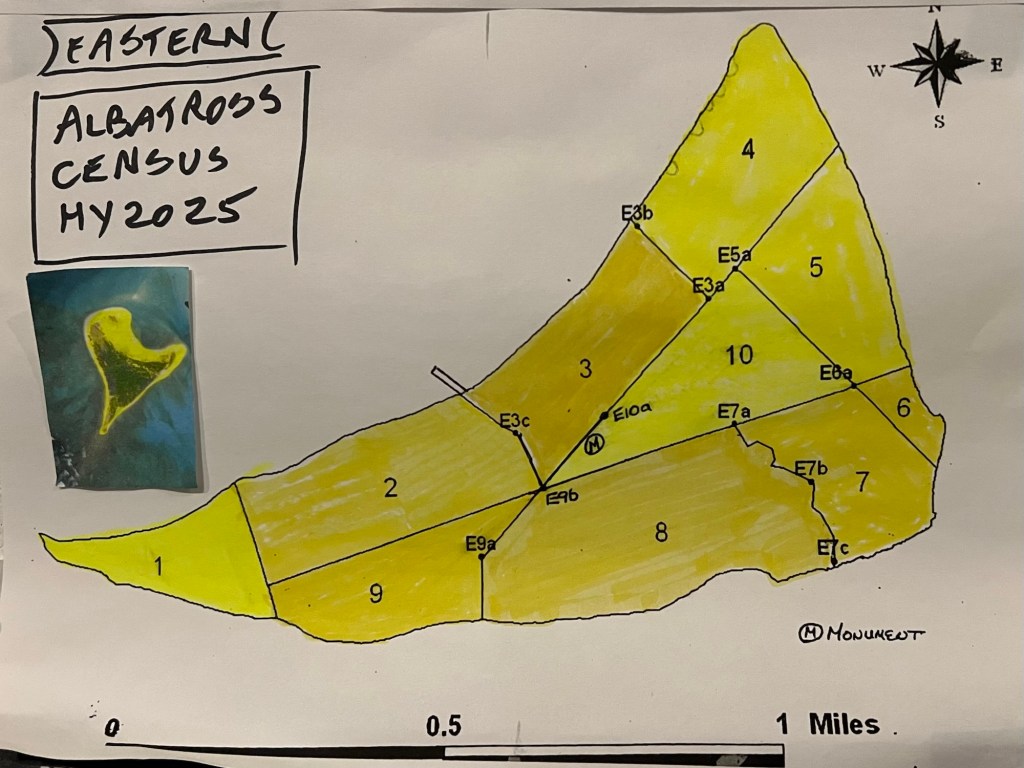
Eastern Island—creatively named, as it lies on the East side of the Atoll😉— is a boat ride from Sand Island where we all live. So, the weather and ocean conditions have to cooperate for us to get there to count.
Pihemanu/Midway Atoll
Eastern Island is something over a mile long and over 1/2 mile wide at its widest point. For our count purposes, it’s divided into 10 sectors, and most of them are humungous! This is my 5th count and I still can’t get my head around how much larger Eastern is than it appears on the map.
The first sector we counted this year took eight of us a full day (well, to be precise, seven for the first half of the morning, then eight). Oh, but what a glorious day it was!
Heading to Eastern early am
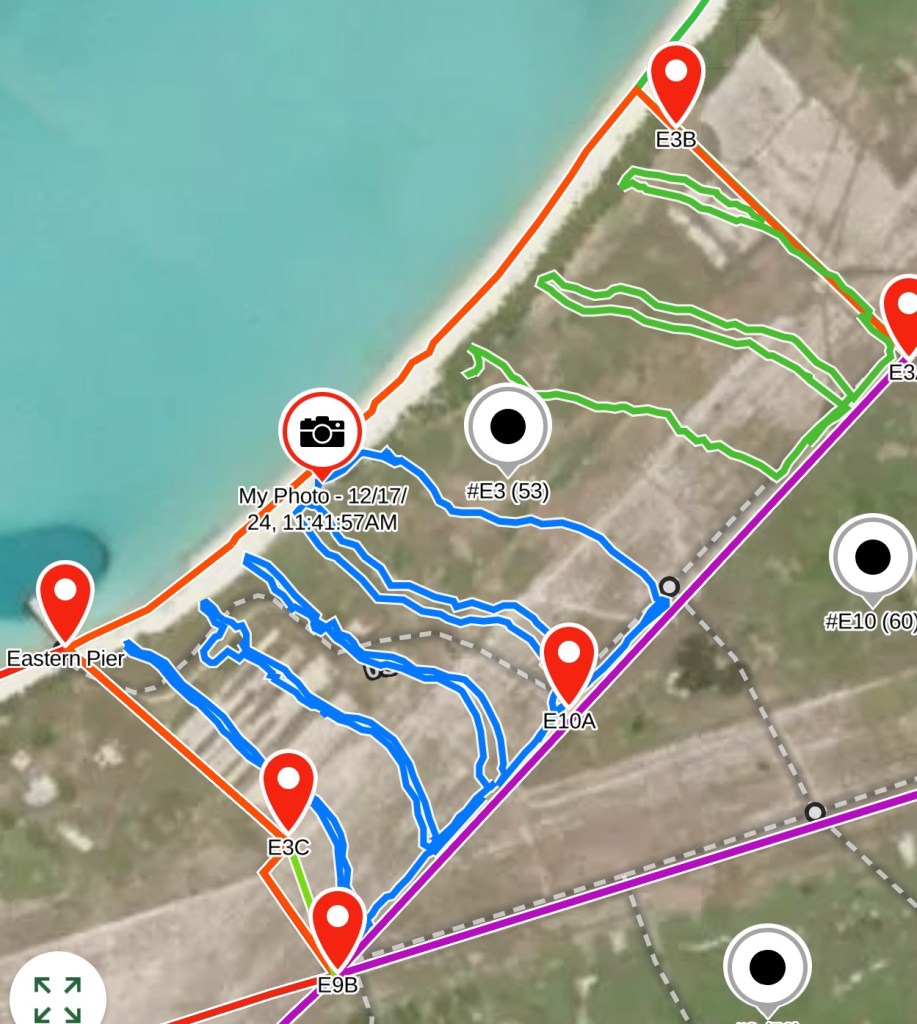
Sector E3 is a large (very very large) rectangle, outlined in blue in the image. Most of it is bordered to the north by a thick band of naupaka.
The most efficient way to count it is to send one person off to the naupaka to paint a line along the front edge, and count everything between it and the ocean, while the rest of the team transect the open area back and forth between the sector border (one of the old WW2 runways) and the painted line.
Here’s a image showing my individual transects (am: blue, pm: green) within the team. 3 hours in the morning, and another hour+ after lunch, followed by the long trudge back to the pier. You can see the tighter, more time-consuming track in the morning when we had one less counter (sometimes two less while one was deep in the naupaka) and also some trickier terrain to cover, such as extra pockets of naupaka bushes.
Thankfully, there are very few Bonin petrel burrows in that sector, so no need for burrow shoes, and we transected the sector mostly uninterrupted, apart from negotiating those smaller pockets of vegetation.
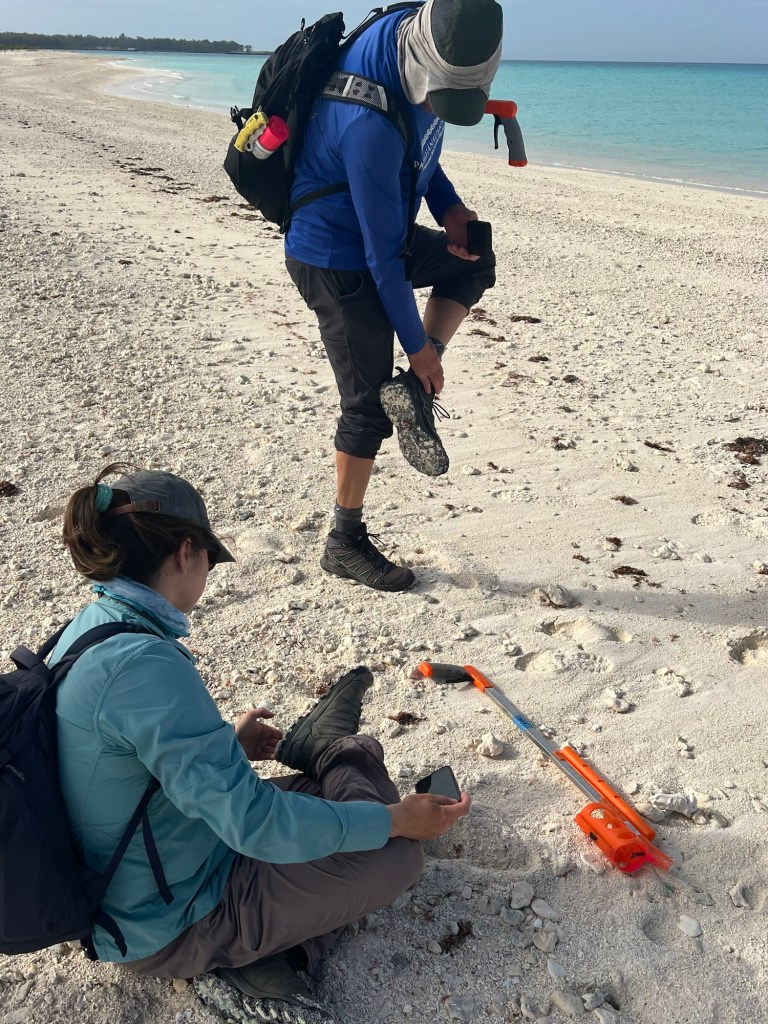
It’s not difficult to find an ideal picnic spot for a lunch break. The entire island is bounded by sandy beach, with a spectacular view of ocean and birds.
Lunch breakTypical Eastern Island landscape
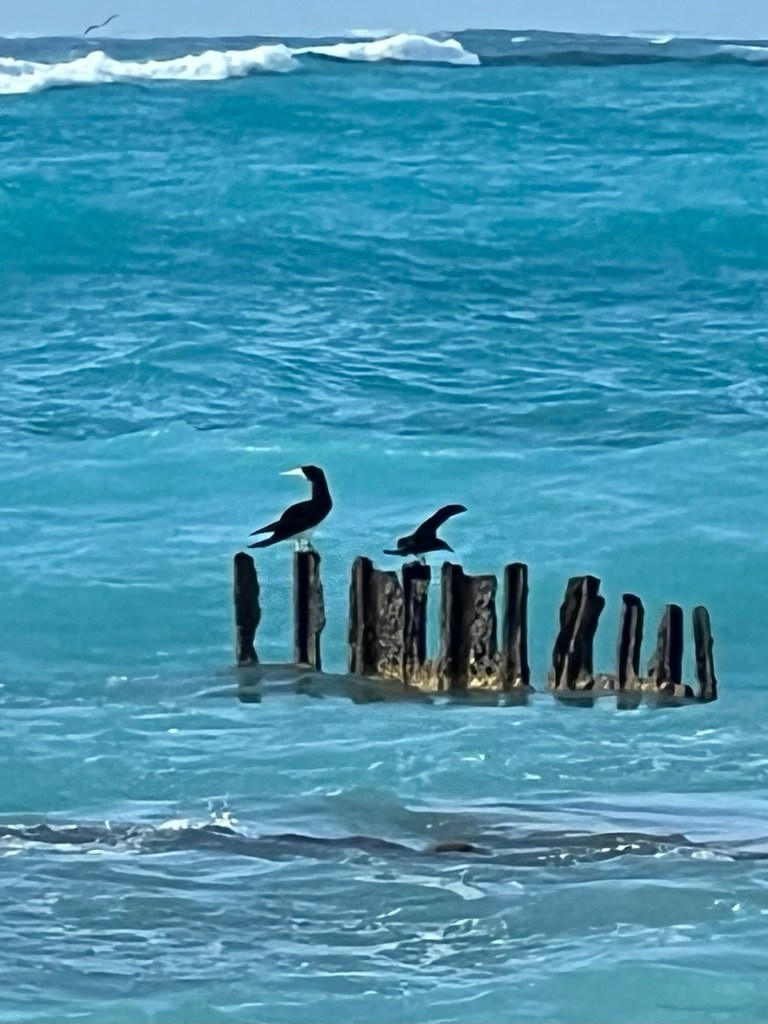
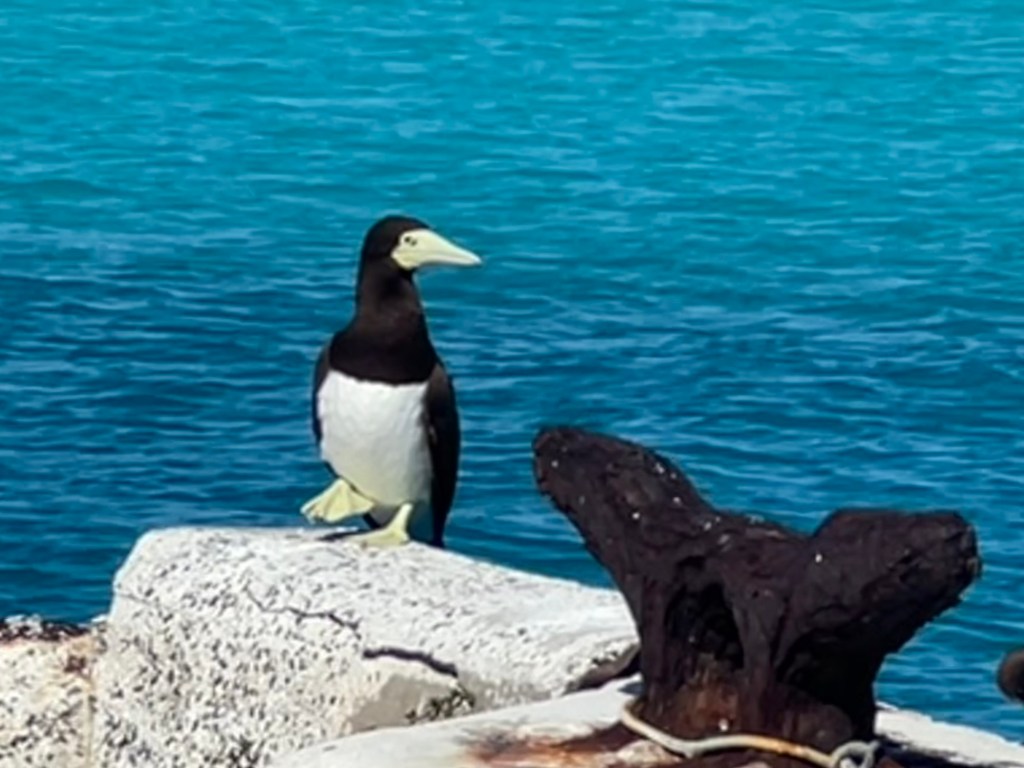
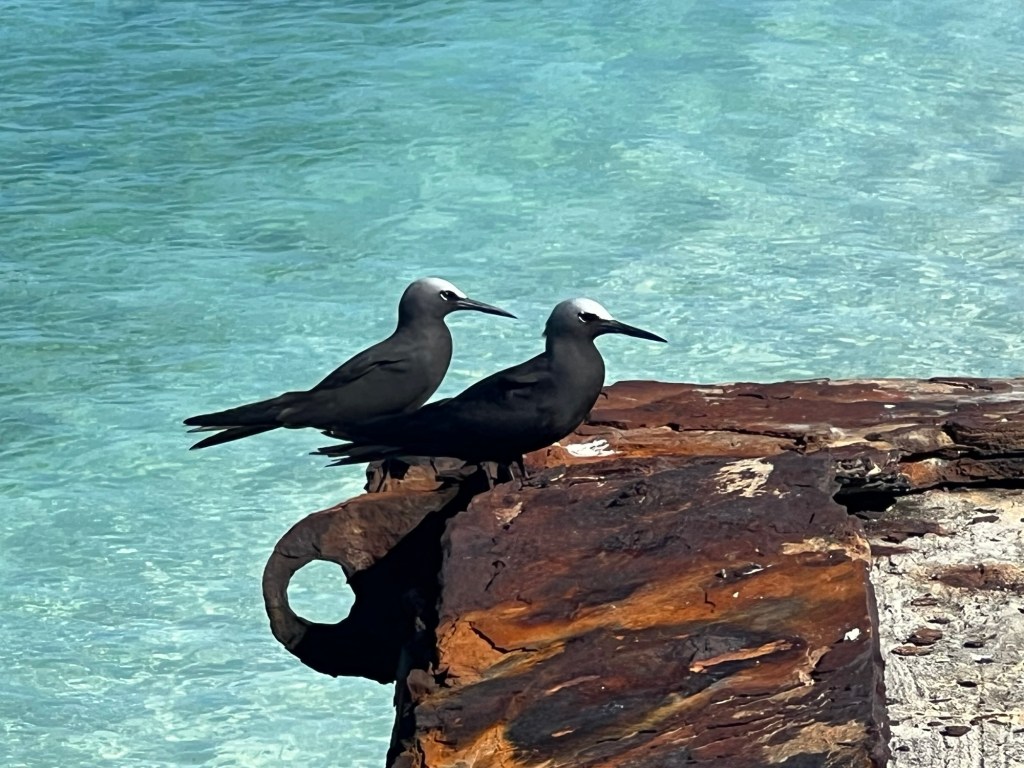
Back on the pier in the afternoon, waiting to be picked up by the landing craft, we were entertained by a brown booby cooling its feet, and a cute pair of brown noddies.
Brown boobyBrown noddy pairBoarding landing craft for return to Sand Island
We returned to Eastern last Friday, this time with our full complement of 12 counters, plus again an additional FWS volunteer for the afternoon after he’d completed his own work. As shown in my track above, having just one extra body widens our line and can add many counted birds to each transect, substantially reducing the time needed for the sector, so we’re always grateful for the extra help.
If anything, Friday’s weather was even better for us, with a light breeze that reduced the temperature by a few degrees.
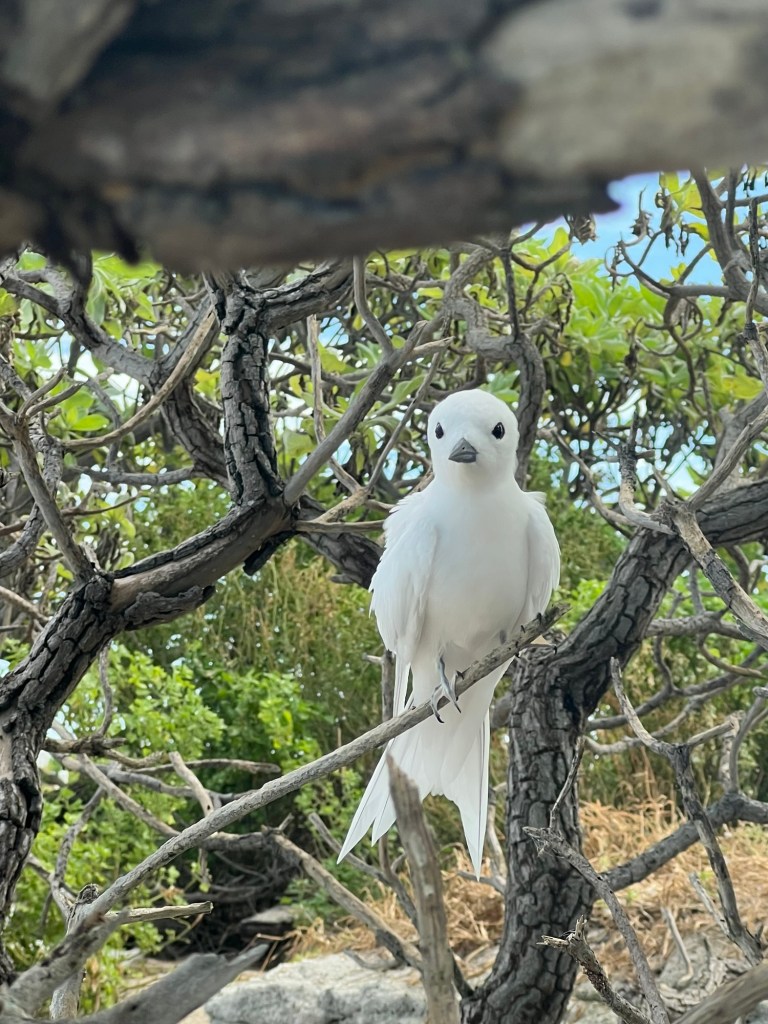
Every visit to Eastern is special, and worth all the effort we expend working our butts off on the count.😊 Friday also gave us a monk seal hauling out in front of us as we ate lunch on the south shore, a white tern awaiting our return to the pier, and a very playful pod of spinner dolphins escorting us on our way back to Sand Island.
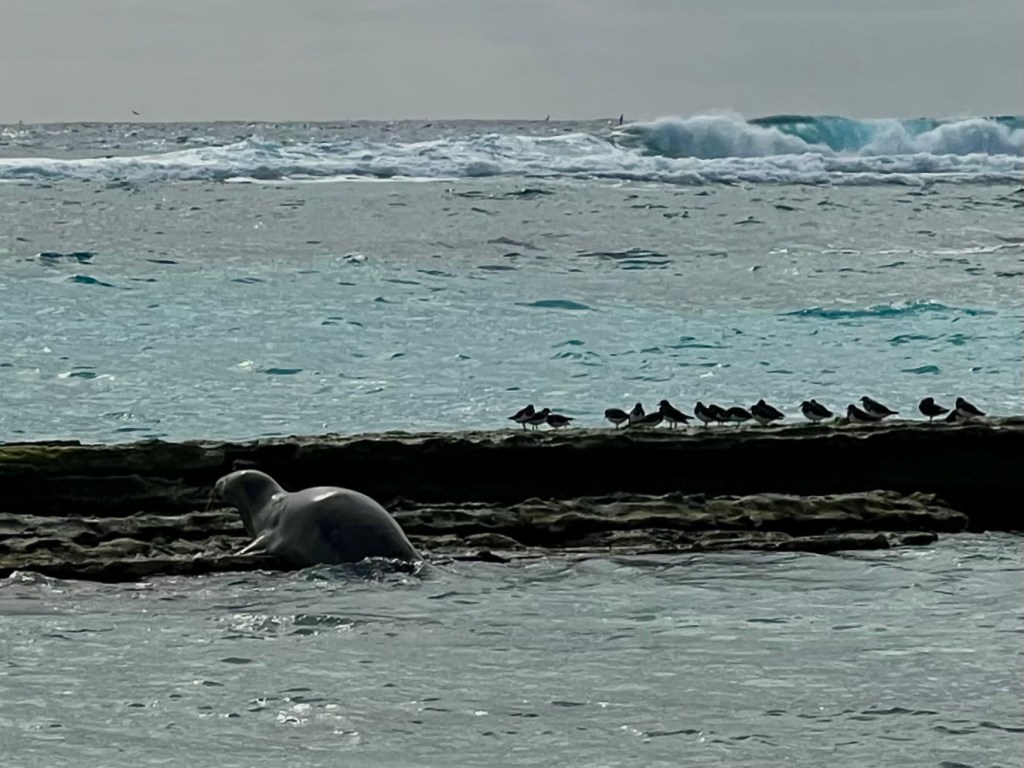
Monk seal and ruddy turnstonesWhite ternView from pier
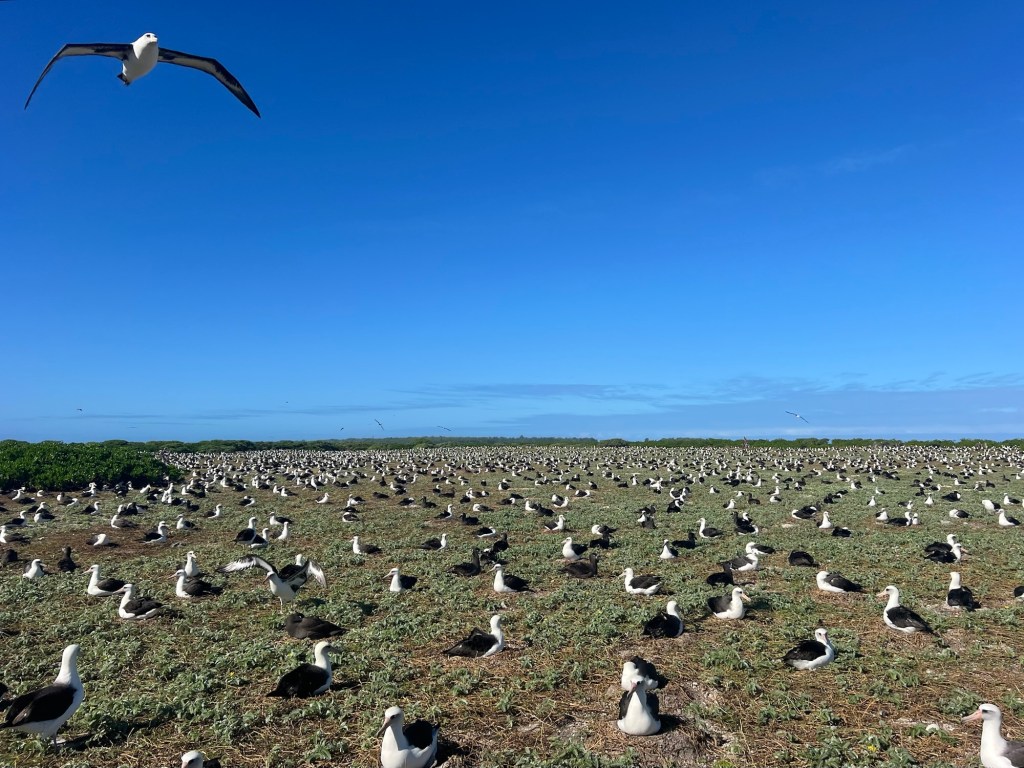
Midway or Midway Atoll, like all the North Western Hawaiian Islands, has its own Hawaiian name, in fact more than one: Kuaihelani (‘the backbone of heaven’) and Pihemanu (‘the loud din of birds’). Pihemanu is particularly apt! The sounds never stop, day or night. When the albatross settle in the evening, the Bonin petrels take over, and the albatross still whistle and clack intermittently all night long.
Last night was a fun Christmas Eve party for everyone on island, kindly hosted by the Refuge Manager at Midway House.
Midway HouseChristmas Eve welcome
The main event, the annual gift exchange, is always full of funny and imaginative gifts, and therefore much stealing…the latest Pihemanu rule is no limit on steals, which led to many truly hilarious interactions!
Christmas Day is traditionally celebrated with a single family-style meal in Clipper House at 11am. The choice of delicious food is almost overwhelming, and everyone brings takeout containers to pack leftovers to last them through til breakfast tomorrow, so that the kitchen staff can at least have a break from one dinner service after all their work preparing for this special meal.
Coming from Kaua’i, it was fun to see they built an Imu (an inground oven) to cook a whole pig.
Imu Midway 2024Pig removedDousing the fire
As I write we’re in the midst of a downpour, so no chance to walk off the Christmas meal. Oh well! Will just have to make up for it when we’re back to counting tomorrow.
We’re fortunate to have had a week of excellent weather, both for our counting efforts and to enjoy the Full Moon this weekend.
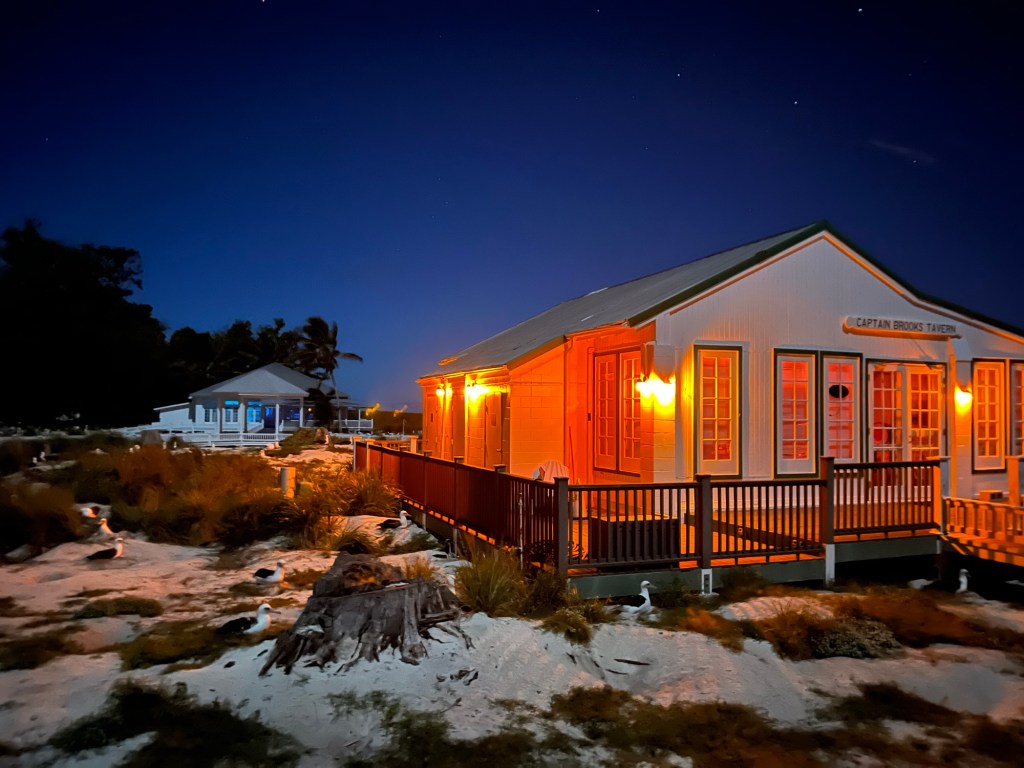
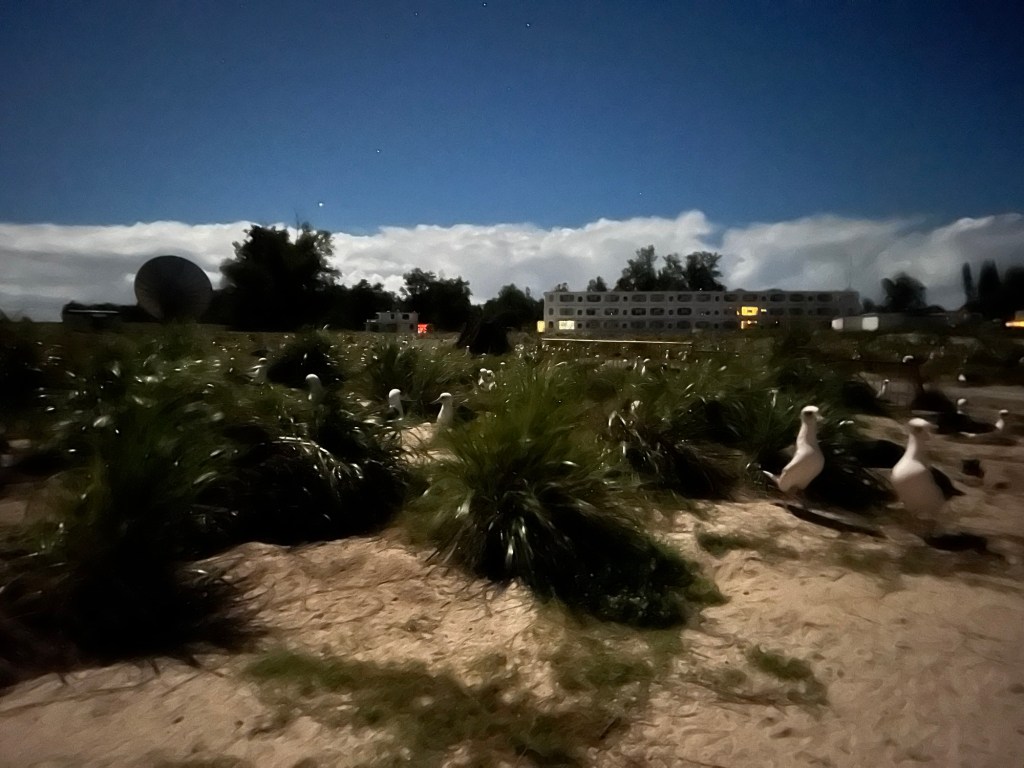
Friday was a movie night at Captain Brookes. One of the island firemen regularly shows a movie and it usually draws a gathering of 10 or 12. Walking home afterwards in bright moonlight was a treat, with the albatross whistling and clacking, while Bonin petrels patroled the skies and squawked on the ground around us as we walked.
Captain Brookes with Clipper House in the distanceCharlie Barracks in the distance
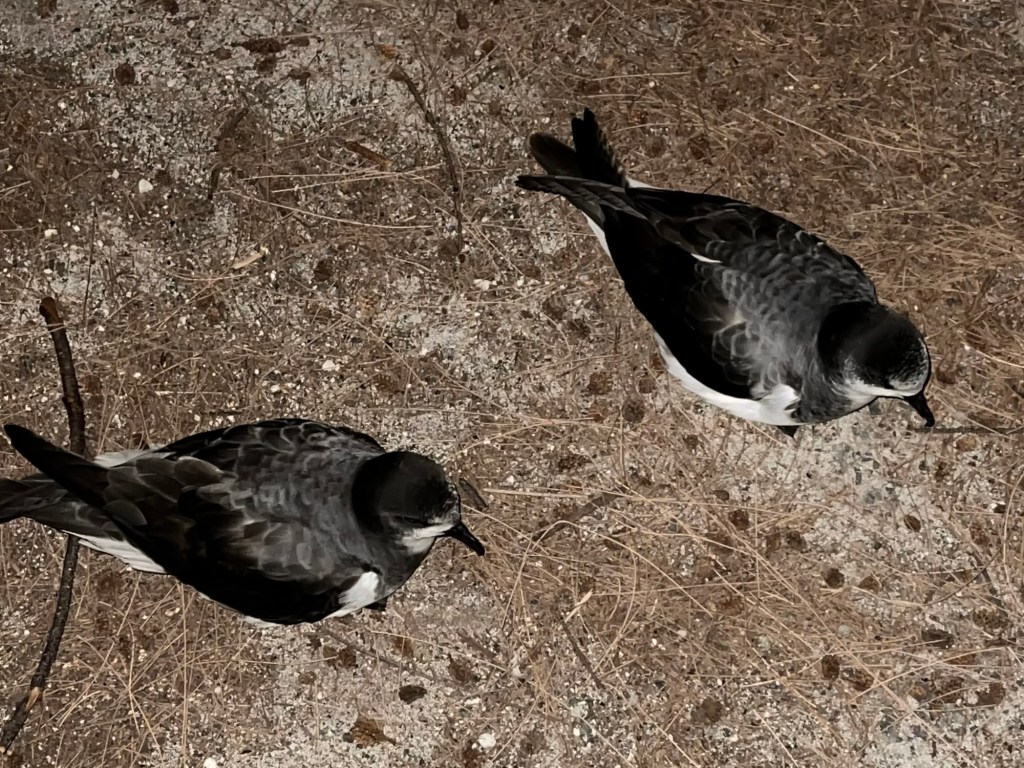
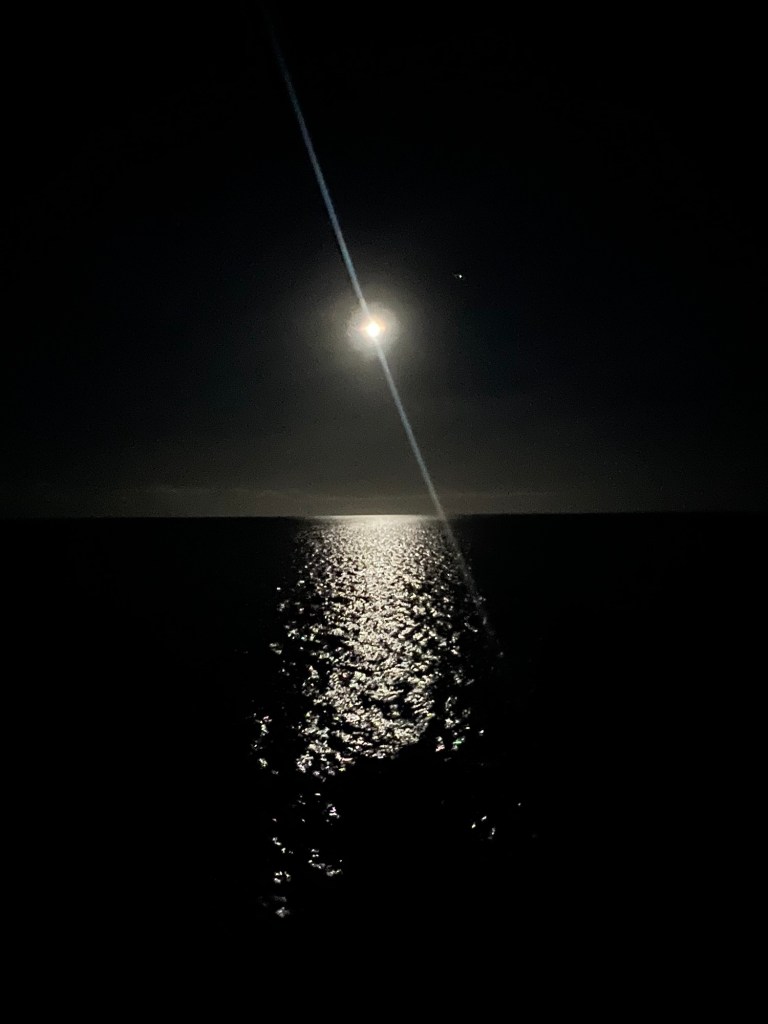
Last night (Saturday) I braved the swarm of Bonin petrels on my bike ride to Cargo Pier, to enjoy the Full Moon.
Cargo Pier & Turtle Beach by moonlight
I was surprised to have the pier to myself, a perfect time for quiet contemplation. I’m so grateful for another opportunity to experience this amazing tiny spot in the Universe.










































 Kauai Greenhorn