Our albatross girls

I must have compiled half a dozen or more posts since my last of December 28. Unfortunately, they were all composed in my head, either while driving around the island (plenty of time for contemplation at a maximum of 50mph), or during one of my frequent bouts of insomnia (which I attribute to age, not location!) So, apologies for the extended absence and, obscenely belatedly, Happy New Year…or, rather less belatedly, Gung Hay Fat Choy!

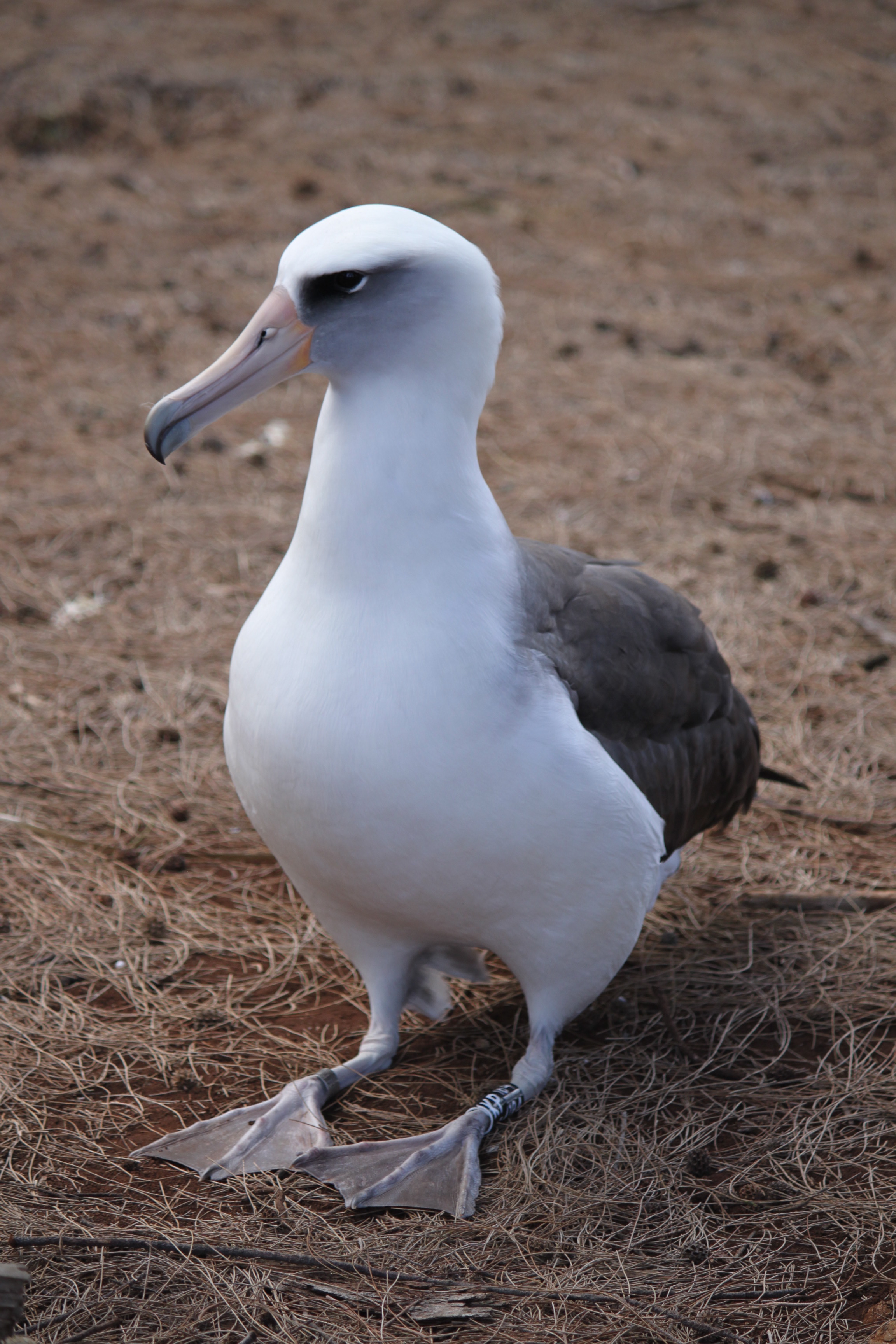
One of the most frequent topics for my mental musings is our local population of laysan albatross. I briefly mentioned some weeks ago that they were/are back on Kauai.

Nov 2012: returning albatrosses find their mates

Nov 2012: returning albatrosses find their mates

They started returning mid- November. Once one appears, it seems they all stream in. After courting and mating, all the nesting pairs concentrate on incubating their (single) egg and raising their chick.

Each parent takes it in turn to fly all the way back to Alaska to feed (yes, seriously, a round-trip of roughly 6,000 miles), while the other is dedicated to sitting full-time on the egg. They swap every two or three weeks until the egg is hatched, then more frequently as the chick grows, often covering the round-trip in only four or five days. Not surprisingly, the nesting bird is too hungry to hang about for long once its mate returns to relieve it.

So, during this incubation stage, the neighborhood goes a little quiet for a while.

IMG_5386However, the activity level picks up considerably early in the new year, when the non-nesters start appearing.
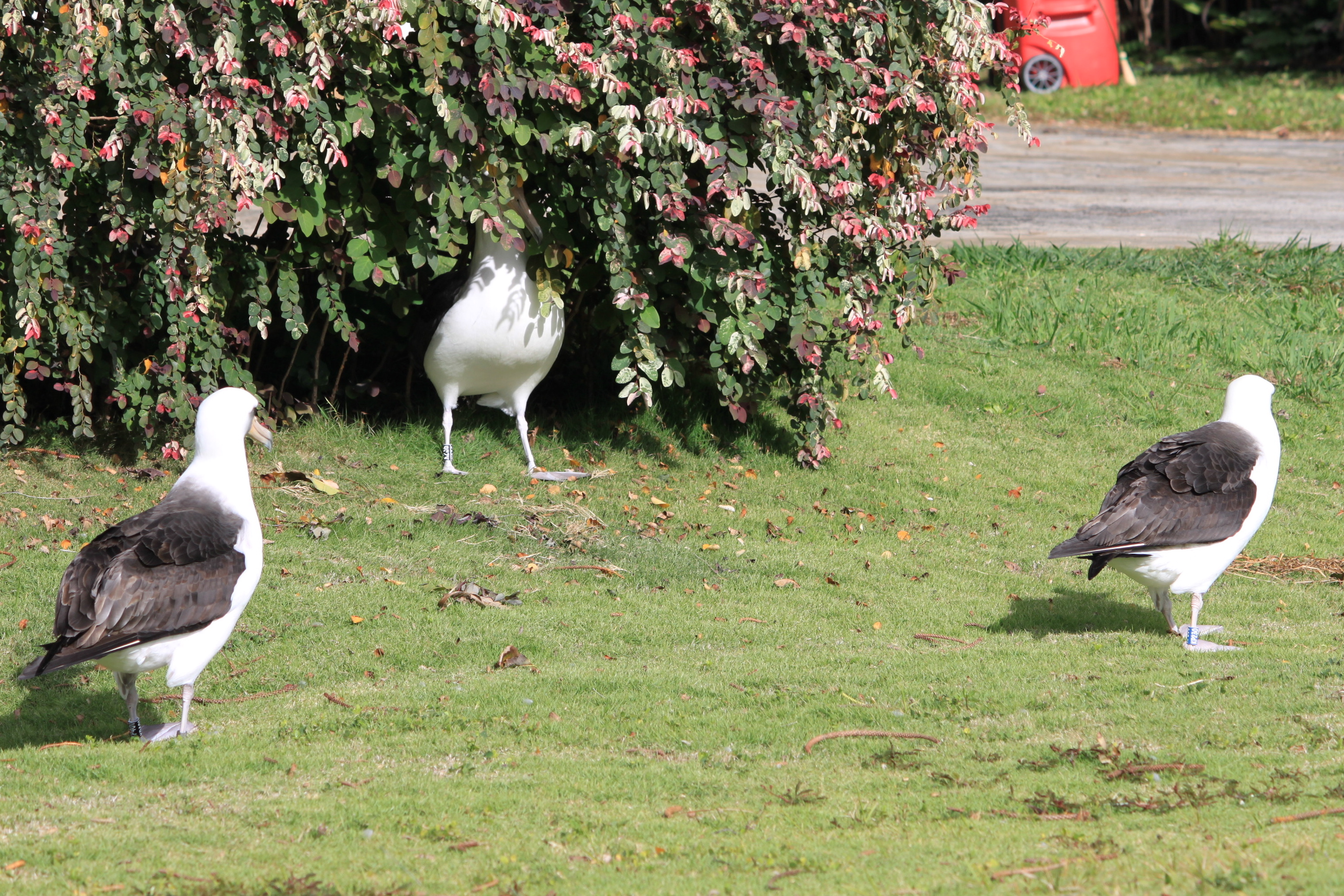
"If I stand really still, perhaps they won't notice me."

“If I stand really still, perhaps they won’t notice me.”

Non-nesters include those adults who for one reason or another do not have a partner this year, as well as the three to seven year old juveniles who are not yet old enough to mate, some of whom have returned to the island for the first time since they fledged (they usually spend the first three years at sea).

Each chick is banded before it leaves the nest; Kīlauea Point and Princeville chicks are given a ‘KP’ prefix. Last year, KP338 and KP643 nested on the border between our home and our neighbor. I learned a little about this pair at that time, but, since we only visited our new ‘vacation’ home for a week or two in February 2012 and again that April, we didn’t see the whole process through all the stages. However, we did find out that they are both females.

We were surprised to discover that female pairs are quite common. It’s not known why this happens, but they are definitely as dedicated as their male/female counterparts in incubating the egg. When both females lay an egg, one of the eggs has to be removed, as they only have the resources to incubate and raise one chick. Of course, the chances of them having a fertilized egg are somewhat limited…but not impossible, since there’s sometimes a randy male hanging around the neighborhood ready to jump their bones when they first return to the area!

Sadly, last year’s egg was not fertile. In some cases, an adoptive egg can be given to an all-female pairing. A program was instigated some years ago to replace infertile eggs with proven fertile eggs from pairs nesting on PMRF (Pacific Missile Range Facility) land. The idea was to reduce the PMRF colony of laysan albatross to avoid collisions with aircraft by relocating the eggs prior to hatching, since an albatross will typically return to the area where it hatched.

Initially, adoptive eggs were relocated to the KPNWR (Kīlauea Point National Wildlife Refuge) only, but it was later extended to those birds nesting on private lands (such as Princeville).

This wasn’t an option for our pair last year as, for some reason known only to herself, 643 decided to move two doors down to lay and incubate her own egg, while 338 was left alone at the original nest site. Without two adults to incubate an egg, there’s no hope of success, since, as I already mentioned, they must take it in turns to leave the nest to feed.

KP338 and KP643 (with 643's egg)

KP338 and KP643 (with 643’s egg) at the top of the slope

This season, the same pair returned, and this time ended up with their nest just a few feet from our garage, on the edge of the driveway. Not that that was their original intention! They started off tucked behind a sago palm and a bird of paradise plant, at the top of a small slope.

643 laid her egg first, on December 4, and left 338 to incubate it.
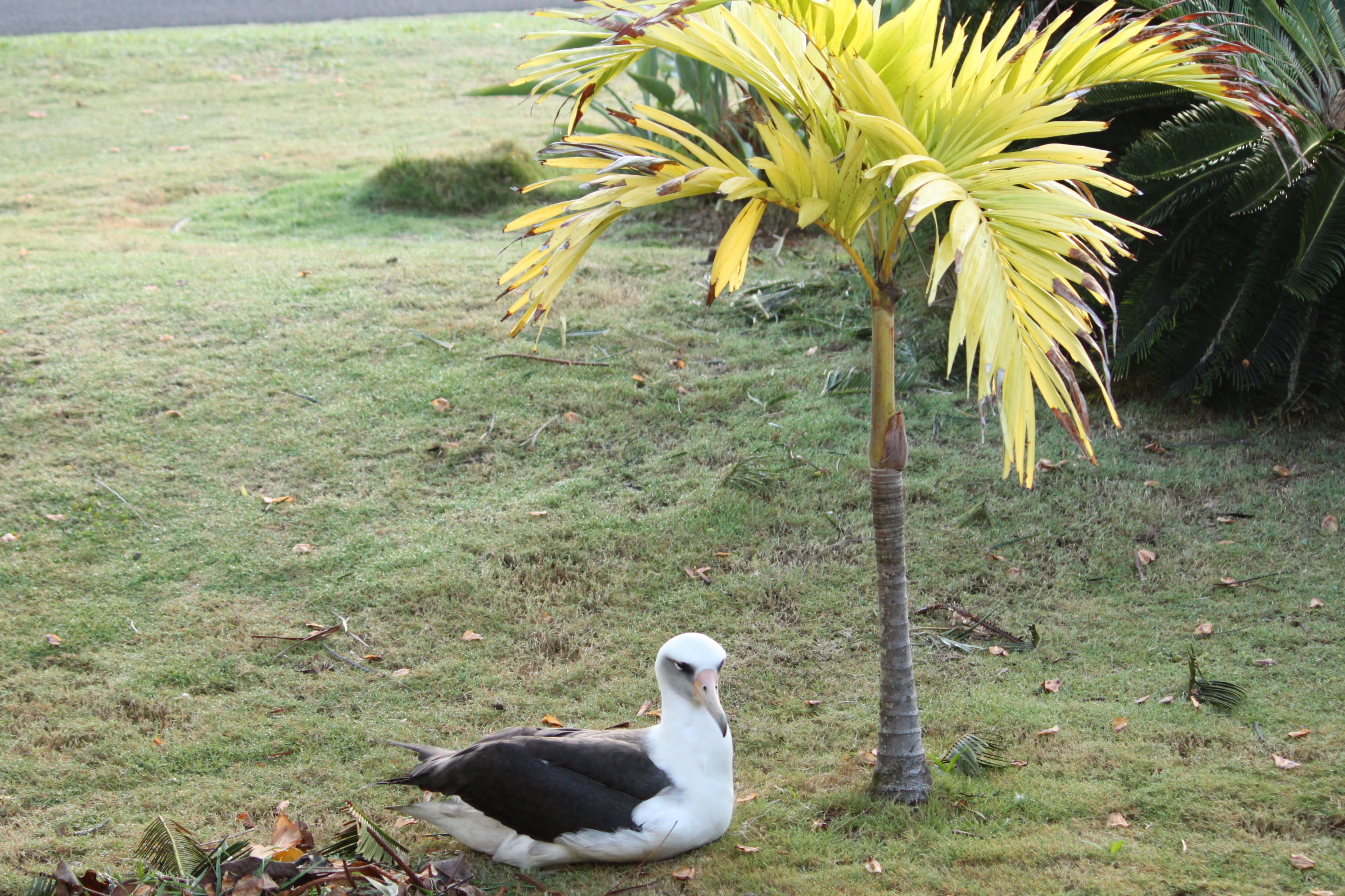
KP338 followed her egg after it rolled down the slope

KP338 followed her egg after it rolled down the slope

338 laid her own egg the following day, slightly to one side … unfortunately, it was closer to the slope and at some point during the day, presumably while 338 was shuffling around and beginning to pull some grass around her to form a nest, the egg rolled down the slope.

KP338 on the eventual nest site, admiring her reflection in the car!

KP338 on the eventual nest site, admiring her reflection in the car!

At least, 338 had the sense to follow her egg and sit on it! (An albatross will often ignore an egg that has accidentally rolled out of the nest, and will stubbornly remain on the nest while the egg goes cold – not the sharpest tool in the box!)

On the positive side, since 338 was by now nesting some distance from the sago palm, it was easy to remove 643’s egg without causing 338 any grief.

To avoid disturbance, the ideal is to keep at least 15 feet away from nesting birds but, given their location, that’s simply not feasible for us, or at least for the car, this year. Thankfully, neither 338 nor 643 seem too bothered by our comings and goings (though, of course, we don’t open the passenger door right next to them). At the risk of imposing human characteristics on these beautiful creatures, our pair do now seem to recognize our voices and appear quite comfortable on their accidental nesting site.

We had hoped that their infertile egg would be replaced with a PMRF egg, but sadly this year the State has decided not to extend the adoption permit to private lands. 😦 So, for now, our pair continue to incubate their egg, with no hope of hatching a chick. At some stage either the egg will break or the pair will simply give up hope and abandon the nest. They have been particularly faithful to each other and to their nest this time, despite the egg relocating itself, so we’re hoping they will have another go next year.
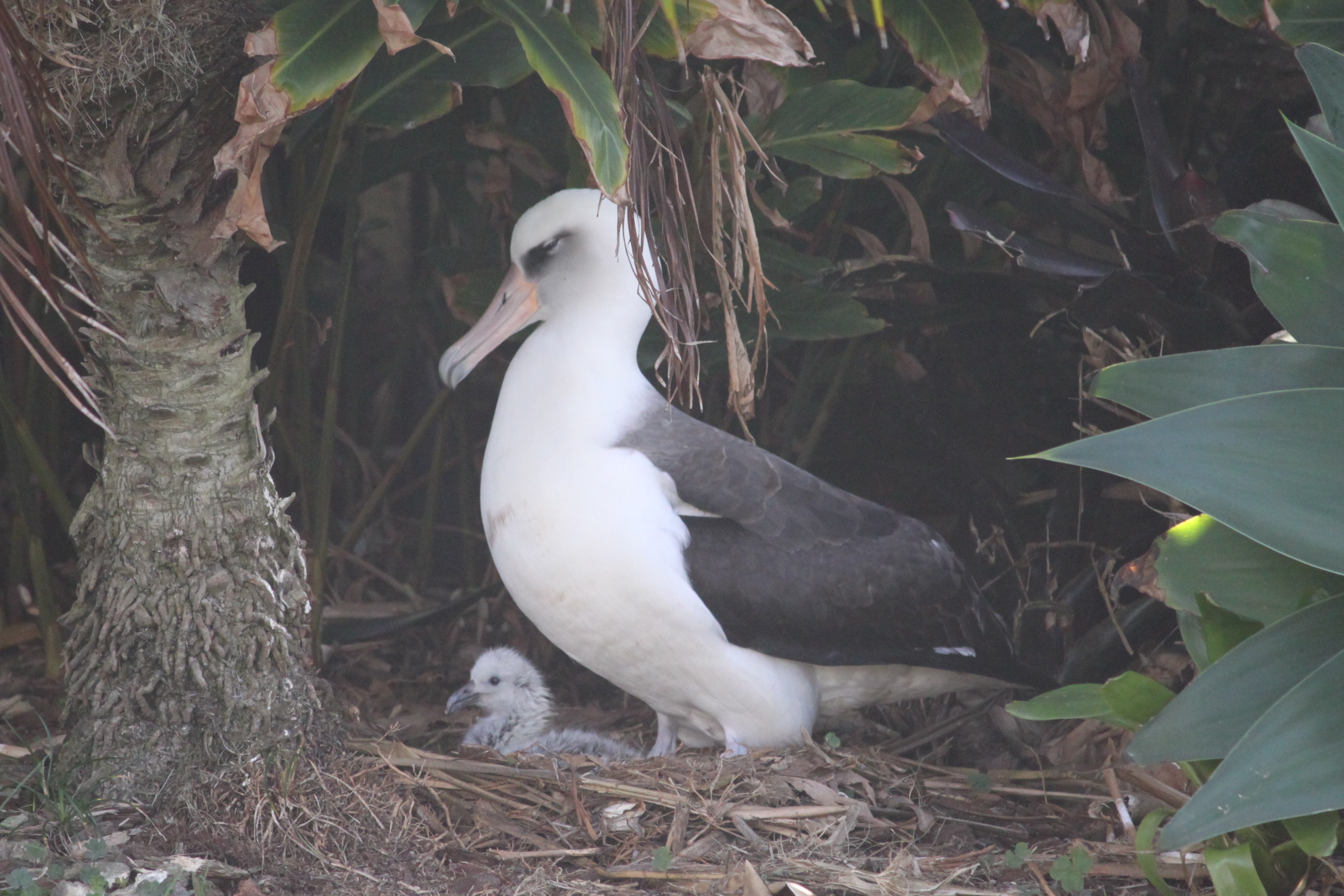
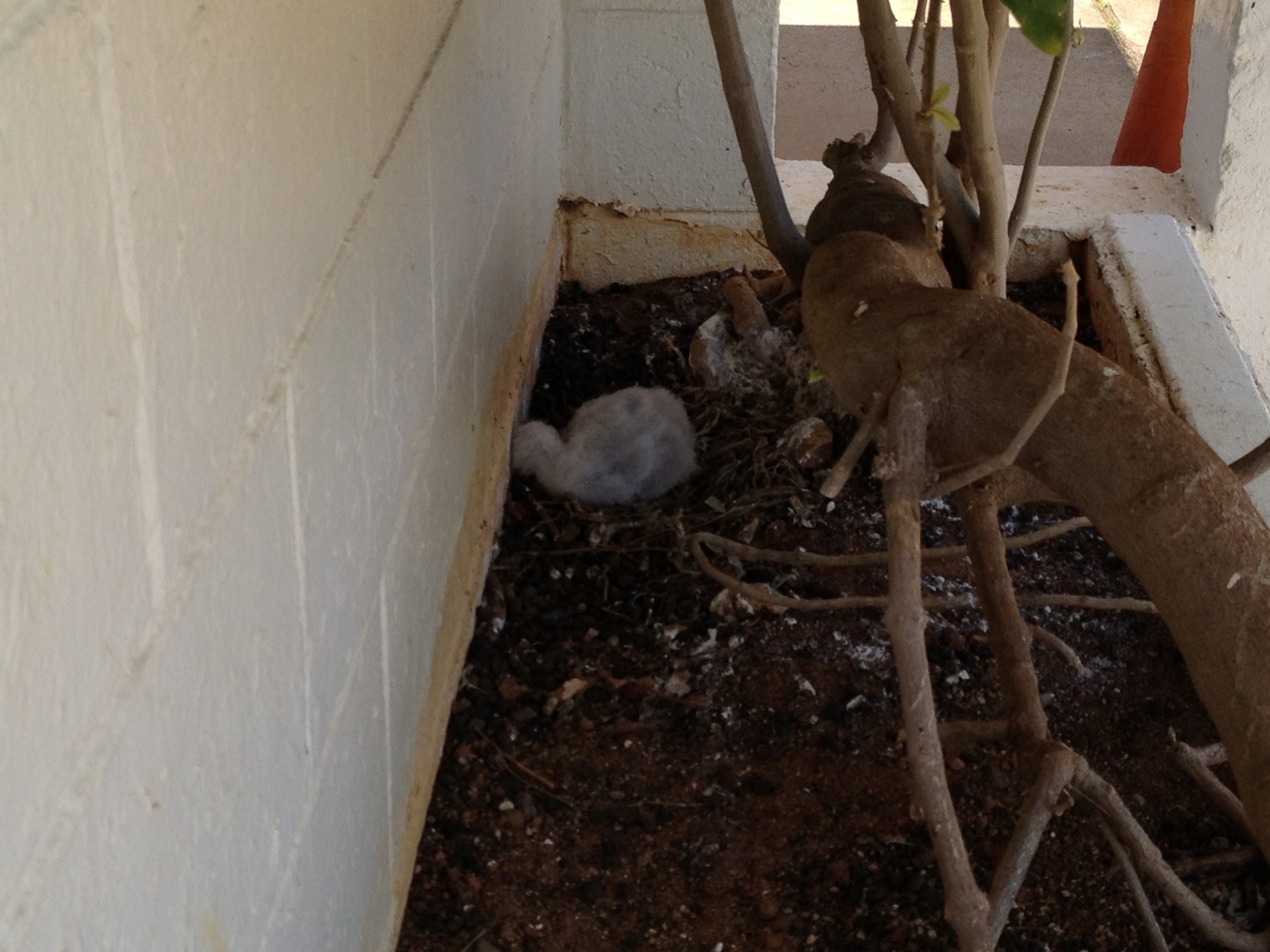
This chick (less than a week old) was hatched on a neighbor's front yard

This chick (less than a week old in the photo) was hatched on a neighbor’s front yard

Meanwhile, the happier news is that we now have 18 chicks in Princeville.

We’re enjoying watching the little balls of gray fluff grow, day by day, in our neighborhood.

Once again, I highly recommend Cathy’s blog, My Albatross Diary, as an excellent and entertaining source for more detailed updates on our Princeville chicks, an insight into albatross parenting, and many more great photos and videos.

Striptease at Kīlauea Point

It been an exciting week at Kīlauea Point!

After almost 4 months of extensive ‘undercover’ renovations, the lighthouse has been disrobed.

It was tough having to mollify numerous visitors, many of whom had traveled thousands of miles hoping to view the lighthouse only to find it shrouded from railing to grass.

Of course, we have had our various seabirds to distract them, and in particular the wedge-tailed shearwater chicks that have featured in more than one recent post; but, for just a few of the most curmudgeonly, even those weren’t sufficient diversion.

This week, however, all that’s changed!

The lighthouse has been stripped naked, and it’s looking glorious!

As we watched the scaffolding being removed on Wednesday afternoon, bit by laborious bit, I was surprised how elated I felt.

When I returned the following afternoon, all the scaffolding was down and being cleared from the site. There is still some work left inside before the week-long centennial celebrations that start on May 1, 2013, but the renovations are currently comfortably ahead of schedule.

The added bonus this week is the return of the albatross.

The first arrived on Sunday, and we currently have four birds on Albatross Hill, to the west of Kīlauea Point.

They’re not easy to see, even with binoculars, from the Point, but I was treated to a brief hike over the hill with one of the staff on Thursday, before I went ‘on duty’.

KP184 was the most accessible of the four, though we were careful to keep our distance, so I was grateful for my zoom lens. Interesting how she it settled down in a semi-seated position. Still, it’s perhaps not surprising if she it was a tad weary after her long journey from Alaska.

Why ‘she’ and ‘her’? Because she’s banded on the left leg. Females are banded on the left, males on the right (except when the rangers very occasionally get it wrong!) 🙂  (see correction below)

Stop Press: Knowing that several albatross had arrived at the refuge, I’d been excitedly anticipating the return of our Princeville ‘residents’; today we had news of the first arrival. My neighbor and fellow Refuge volunteer, Cathy Granholm, has studied our local albatross for many years; she regularly checks the nests in yards and golf courses throughout Princeville, keeping detailed notes, and her blog is full of wit and wisdom. She takes a rest from blogging while the albatross are away, from August to November, so I was delighted to read her first post of the season today, and am looking forward to many more informative and entertaining posts over the next few months.

*CORRECTION*

I’m indebted to Cathy, not only because she bothered to read my post ;), but also because she quickly set me right about the banding. It seems that they can’t band albatross females and males differently, because the only definitive way to confirm the sex is by taking a feather and doing a DNA test. Apparently, all their ‘personal bits’ are very well hidden, on both genders!

It is true that the nēnē (Hawaiian geese) are banded left-leg for females, right-leg for males, and I had been reliably (I thought) informed the same method was used for the albatross. However, in the interests of retaining good relations, I will refrain from disclosing my source; suffice to say that, at the time, I was confident the information was accurate. Now I’m beginning to understand how the Beeb and Newsnight got themselves into such deep doodoo! 😦

Returning roosters at Kilauea Point

…and, by roosters, I do not mean the omnipresent Kauai chicken!

At the Kilauea Point National Wildlife Refuge (KPNWR) the Wedge-tailed Shearwater chicks (‘Wedgies’) are getting close to fledging. The oldest of the visible chicks will probably be gone within the next couple of weeks. Which means the adults will no longer return to feed them. Adults and fledglings will all (individually) fly south to the Gulf of Panama for their winter vacation.

So, Steve and I headed out to the overlook at Kilauea Point just before sunset one evening last week, hoping to catch a glimpse of the adult Wedgies returning to their burrows and their chicks dotted around the Point.

If they did, we missed them! However, while we were waiting, we were treated to the marvelous sights and sounds of the Red-footed Boobies returning to their roosts.

The adults have bright red feet (I guess their name gave that away, didn’t it!), and also a very blue bill – a bizarrely beautiful color scheme.

These boobies stay with us year-round, and the evening ritual is evidently a popular sight, as we were joined by a number of visitors while we were there.

Our next ornithological treat will be the return of the Laysan Albatross from their Summer break in Alaska which should be any day now! During the three-month break between last seasons fledglings in July and the anticipated adult arrivals, I’ve been enjoying some local albatross stories and photos posted by Bob Waid, a neighbor and fellow volunteer at KPNWR.

KPNWR’s newest recruit at Kilauea Point

Tuesday marked my first day on the ‘job’, as a volunteer at the Kilauea Point National Wildlife Refuge (KPNWR).

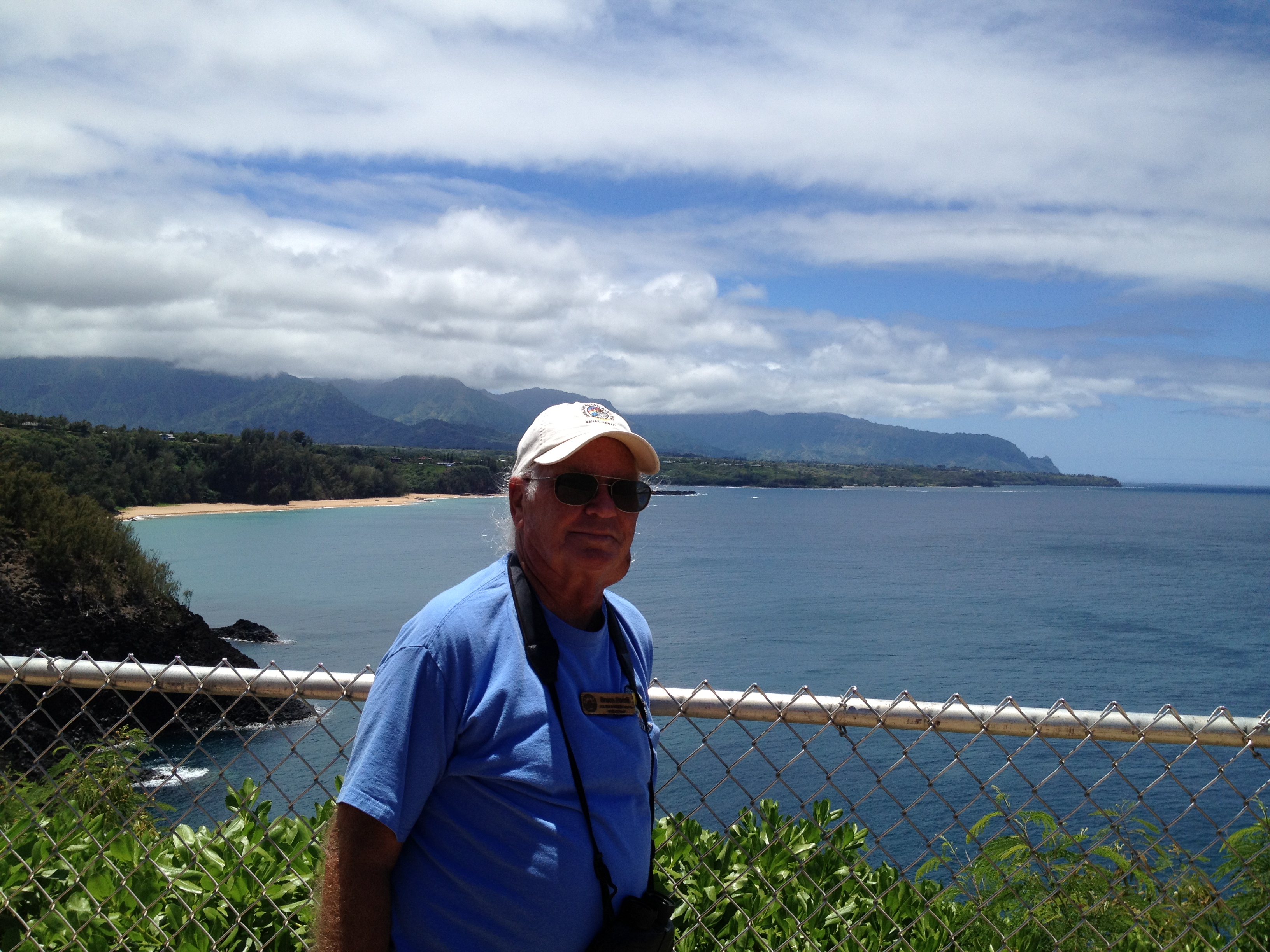
I had a brief orientation with Jennifer Waipa who’s the park ranger responsible for the volunteers. Then, for the afternoon shift from 1 to 4pm, I shadowed a long-time, very experienced and equally entertaining volunteer named Bruce Parsil.

Bruce Parsil, knowledgeable and entertaining mentorI felt like a new kid on the first day at school, and the afternoon was a great experience: perfect weather, with sufficient wind for the birds to be constantly playing and drifting all around us, and a ton of fascinating information to absorb from Bruce.

The main residents at this time of year are the frigate birds, shearwaters, red-footed boobies, and tropic birds (both white-tailed and red-tailed). The Laysan albatross have already bred, the youngsters have fledged, and all have returned to sea.

Btw, if you caught my previous post about the late-bloomer albie in our neighboring street, I’m delighted to report it fledged Monday morning, sometime between 7:30am when the owner went to work and noticed the youngster was still hanging out, and 8:15 when I walked Freya and it was gone…oh and, Nan, I admit my biased gender assumption was wrong, apparently it was a ‘she’! 😉

Here are just a few of the many facts I learned from Bruce and Jennifer (these notes are as much for a memory for myself as for any reader’s edification): 

  • ‘Our’ frigates are female only. No breeding occurs here; they just seem to hang out and chill. Either they are non-breeding females, or they are stopping off on their way to or from their breeding grounds. So, sadly, not much chance of the glorious sight of a male frigate with his huge engorged red throat.
  • There are two species of shearwater on the island, the Wedge-tailed Shearwater and the smaller Newell’s Shearwater. The ‘wedgies’ are not endangered, and breed in burrows around the bluff including close to pathways (so close that sometimes the chicks fall out and roll down the path). The Newell shearwaters, on the other hand, are endangered, and usually breed further inland…high in the mountains. However, a recent program seems to have been successful in establishing a number of Newells on refuge land.
  • The shearwaters are now hatching. The first wedgie on the refuge hatched three weeks ago and, surprisingly, is situated in one of the most public, exposed areas, immediately outside the interpretation center beside the lighthouse. The parents return year after year to nest in that spot, so evidently the human activity doesn’t bother them too much. The chick is currently a cute pale gray/white fluffball which attracted a great deal of visitor interest and gave me several opportunities to regurgitate Bruce’s words of wisdom.
  • There is a hybrid tropic bird. The traditional white-tails have a pale beak, and the red-tails have a red beak…then there’s the hybrid that has a white tail and a red beak! I know, I’ve seen them!

I’ve omitted any details about the red-footed boobies…they will probably have a dedicated post in the future.

There were some other entertaining sights as well as the birds. We spotted a large number of spinner dolphins, who often hang out in the bay to the west of the Point until mid-afternoon, and we had just one sighting of a green turtle. No monk seals that afternoon, but I’ve seen one near the Point in the past.

Moku’ae’ae islet off Kilauea Point

Even an albatross can have a bad hair day

The albatross return each year to breed on Kauai. Since they are exceedingly ungainly on land (hence their nickname of gooney birds) and require an extensive runway for landings and take-offs, a few roads in our area close to the bluff are prime nesting sites.

The adults return in November. Courtships, egg-laying, hatching, and chick-rearing follow. Eventually the parents leave the almost full grown chicks, and by mid-to-late July all the youngsters have fledged. All, it seems, except one this year.

Albatross bad hair dayThis one chick is evidently a late-bloomer, or just plain lazy, but I am delighted he hung around long enough for our arrival this week. I’ve had the pleasure of watching him grow during my previous visits in February and again in April, so it’s a treat to witness the final stage in this year’s cycle.

As the chicks lose their baby fluff and gain their sleek adult plumage, each has its own highly amusing pattern of ‘hair’ loss!